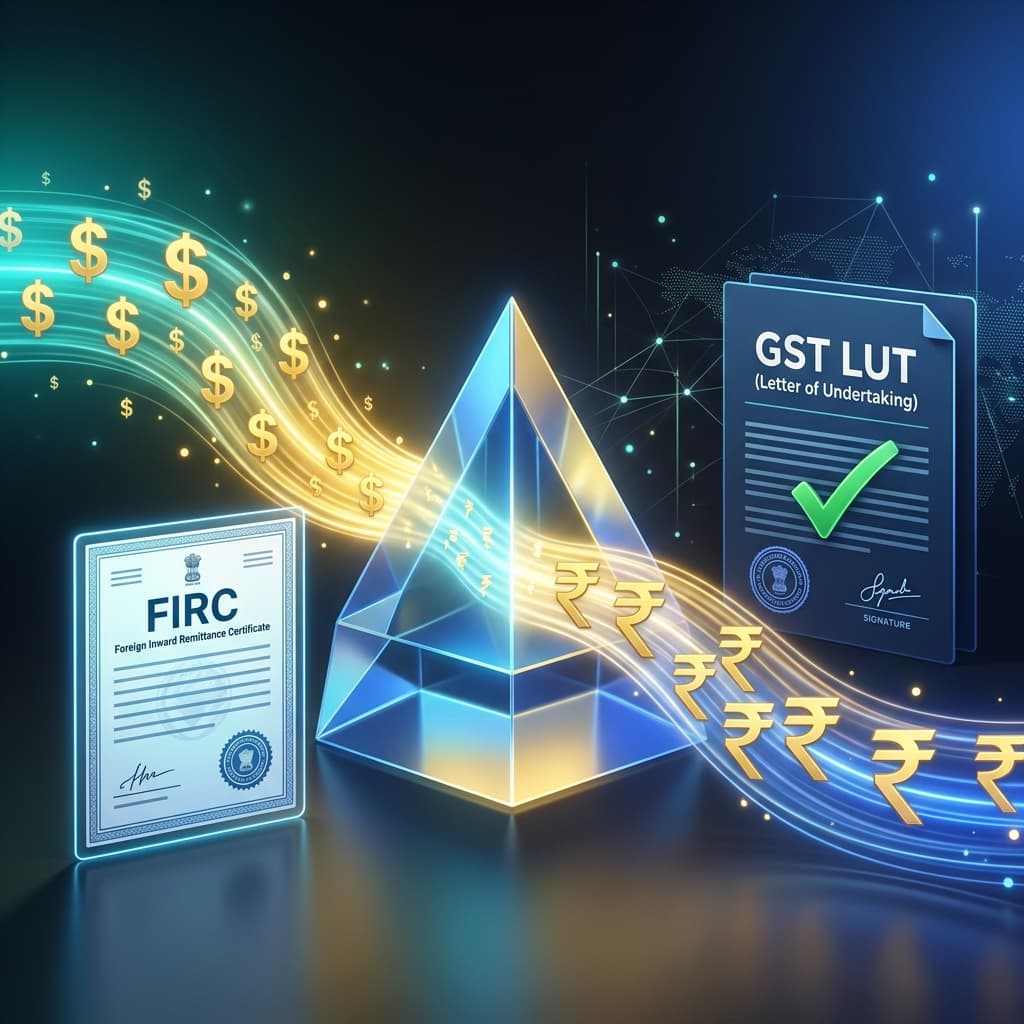
Landing your first foreign client is an intoxicating milestone. The numbers on the screen look beautiful: a $3,000 contract or a $5,000 monthly retainer. Translated to Indian Rupees, it feels like an absolute jackpot. You are no longer competing in the local market; you are earning in a hard currency (USD, EUR, GBP) while living in a lower-cost-of-living country. It is the ultimate financial arbitrage.
But then, reality hits your bank account.
You invoice your client for $5,000. They transfer the money via PayPal. When the rupees finally clear in your local savings account, you do the math: you only received ₹3,86,000.
But Google says $5,000 is worth exactly ₹4,20,000 today!
"Where did my ₹34,000 go? Who took my money? And wait, what is this email from my bank asking for a 'Purpose Code'? Do I need to pay 18% GST on this? What is a GST LUT?"
Welcome to the complex, leaks-prone world of global freelancing. When you work with foreign clients, the financial system doesn't just charge you a fee—it bleeds your profits through a combination of upfront transaction charges, hidden currency exchange spreads, and regulatory friction.
Fortunately, you don't have to accept this leakage as the cost of doing business. The Indian tax and banking systems have structured pathways to let you receive foreign income with exactly 0% GST and minimal fee leakage—provided you follow the rules.
In this masterclass guide, we will break down the regulatory rules of foreign client freelancing in India and introduce a simple, bulletproof system to protect your money: The L.I.N.K. Remittance System.
The Core Concept: The "Export of Services" Tax Shield
Before we talk about banks and fees, let’s talk about the law. Under the Integrated GST (IGST) Act, when you do freelance work for a client located outside India, you are not just a freelancer. You are classified as an Exporter of Services. 1
Under Section 2(6) of the IGST Act, a transaction qualifies as an export of service if and only if:
- •The provider of service is located in India.
- •The recipient of service is located outside India.
- •The place of supply is outside India.
- •The payment for such service has been received by the provider in convertible foreign exchange (USD, EUR, GBP, etc.).
- •The provider and the recipient are not merely different establishments of the same business.
The 0% Tax Benefit (Zero-Rated Supply)
Under Section 16 of the IGST Act, the government treats the export of services as a Zero-Rated Supply. This is a massive tax shield. The government wants you to bring foreign currency into the country, so they set the tax rate on your services to exactly 0%.
However, you cannot just default to 0% because your client is in California. To legally claim this 0% tax shield, you must follow the steps of The L.I.N.K. Remittance System.
The Simple System: The L.I.N.K. Remittance System
To manage your global clients and incoming payments cleanly, follow these four rules:
  L - LUT (Letter of Undertaking)
  I - Invoice in Foreign Currency
  N - Net Fee Optimization
  K - Keep the FIRC
Let's break down each component of this framework so you can apply it immediately.
L - LUT (Letter of Undertaking)
To claim the 0% GST rate on your exports, the law requires you to file a Letter of Undertaking (LUT) annually.
1. What is an LUT?
Under GST rules, if you export services, you have two options:
- •Option A (The Hard Way): Pay 18% IGST upfront on every invoice, file for a refund on the GST portal, and wait months for the department to clear it.
- •Option B (The Easy Way): File an LUT (Form GST RFD-11) online, which acts as a legal promise to the government that you will bring the foreign currency into India within 9 months. In exchange, you get to invoice at 0% GST upfront. No cash outflow, no refund filings.
2. How to File an LUT (Step-by-Step)
Filing an LUT is completely free, takes 5 minutes, and is done entirely online:
- •Log into the GST Portal (www.gst.gov.in).
- •Navigate to Services > User Services > Form GST RFD-11 (Furnish LUT).
- •Select the Financial Year for which you are filing.
- •Enter the names, addresses, and signatures of two witnesses (colleagues, family members, or friends).
- •Sign the form using your Digital Signature Certificate (DSC) or Aadhaar OTP (EVC).
- •Once submitted, your LUT is instantly approved. Download the PDF and keep it on file.
[!WARNING] The April Deadline: An LUT is only valid for one financial year. You must file a fresh LUT every year before April 1st to continue invoicing at 0% GST. If you invoice a foreign client in May without a valid LUT for that financial year, the transaction legally attracts 18% GST, exposing you to severe tax penalties.
3. What if I am below the ₹20 Lakh GST Threshold?
Under the GST Act, services are exempted from registration if your aggregate annual turnover is under ₹20 Lakhs (or ₹10 Lakhs in special states). If your total freelancing receipts are ₹12 Lakhs a year, you do not need to register for GST or file an LUT. You are exempt. However, the moment your receipts cross ₹20 Lakhs, GST registration becomes mandatory, and filing your LUT becomes your very first task.
I - Invoice in Foreign Currency
An export invoice is not a standard bill. To protect yourself in a GST audit, your invoice must be designed according to specific legal requirements.
1. Crucial Invoice Fields
Your invoice must clearly display:
- •Your name, address, and GSTIN.
- •A unique, sequential invoice number.
- •The Client's Foreign Address.
- •The Currency of Invoice (e.g., USD, EUR).
- •The GST Clause: You must print the exact endorsement text on the invoice: "Supply of services meant for export under bond/LUT without payment of integrated tax."
2. The Place of Supply Rule
For service exports, the Place of Supply (under Section 13 of the IGST Act) must be outside India. For digital services like software engineering, design, writing, or marketing consulting, the place of supply is the location of your client. If your client is in Delaware, the place of supply is Delaware, validating your export status.
N - Net Fee Optimization (Stopping the Leaks)
Now, let’s address the elephant in the room: How the payment networks slice your hard-earned money.
When a client transfers USD to India, the transfer goes through three gates:
- •Fixed Fees: The flat cost to initiate the transfer.
- •Conversion Margins (Markups): The percentage markup added to the interbank exchange rate.
- •Intermediary Fees: Correspondent bank fees charged as the money hops between international banks.
Let's look at the three most common remittance methods and analyze where the leaks happen.
1. PayPal: The Convenience Trap
PayPal is the most common payment tool in the world. It is highly convenient, but for a freelancer, it is a financial disaster.
- •The Upfront Fee: PayPal charges an export transaction fee of 4.4% + a fixed fee ($0.30).
- •The Exchange Rate Markup: This is where they bleed you dry. PayPal does not convert currency at the Google/mid-market rate. They add a hidden markup of 3.5% to 4% to the exchange rate.
- •The Total Cost: You lose roughly 7.5% to 8% of your invoice amount to PayPal!
2. Wise (Formerly TransferWise): The Transparent Alternative
Wise operates on a completely different model. They do not use the SWIFT network to move money across borders. Instead, they have local bank accounts in both countries.
- •The Rate: Wise converts your USD at the exact mid-market exchange rate (the Google rate) with zero markup.
- •The Fee: They charge a small, transparent variable fee (usually 0.5% to 0.6% of the transfer amount).
- •The Total Cost: You lose only 0.5% of your invoice.
3. Direct SWIFT Bank Wires: The Heavyweight Route
If your client pays via international wire transfer (SWIFT) directly to your Indian bank account:
- •The Rate: The bank converts the funds using their daily retail forex rate/card rate. For standard accounts, banks add a markup of 1.2% to 2%. However, if you receive more than $5,000 monthly, you can call your bank's forex desk and negotiate a "special rate" (markup of 0.2% to 0.5%).
- •The Fees: A flat inward remittance fee of ₹200 to ₹500 + GST, plus a $10 to $20 correspondent bank fee.
- •The Verdict: SWIFT wires are expensive for small transfers under $1,000, but they become highly cost-effective for large transfers above $5,000 if you negotiate your forex markup with your bank.
K - Keep the FIRC (Foreign Inward Remittance Certificate)
Filing your taxes and getting the money is only half the battle. You must prove to the government that the money arrived legally under the guidelines of the Reserve Bank of India (RBI) and the Foreign Exchange Management Act (FEMA).
Your ultimate shield is the Foreign Inward Remittance Certificate (FIRC).
1. What is an FIRC?
An FIRC is an official document issued by an Authorized Dealer (AD) bank confirming that foreign funds have entered the country, the purpose of the transfer, and the conversion rate into INR. 2
2. Why is it Mandatory?
- •GST Audit Proof: If the GST department notices you registered ₹30 Lakhs of turnover but paid 0% tax, they will audit you. If you cannot produce the FIRC for every invoice, they will treat the transactions as domestic sales and demand 18% GST + interest.
- •FEMA Compliance: Under FEMA rules, all export proceeds must be realized and brought into India within 9 months. The FIRC is your official proof of compliance.
3. How to Get an e-FIRC
Since the RBI digitized the process, banks report remittances to the Export Data Processing and Monitoring System (EDPMS).
- •Direct Bank Wires: Your receiving bank (e.g., ICICI, HDFC) will issue an e-FIRC or a remittance advice upon request, usually for a small fee of ₹100-₹500.
- •Wise / Payoneer: Since Wise routes funds domestically through Indian partner banks (like IndusInd Bank or Yes Bank), your local bank statement will show a domestic transfer. You must log into Wise, download the FIRC Advice, and request the official e-FIRC from the partner bank using the reference number.
- •PayPal: You must log into the PayPal portal and apply for a monthly FIRC, which is generated electronically for a fee.
Aanya’s Math: A Head-to-Head $5,000 Transfer Comparison
Let’s look at Aanya, a freelance UX researcher in Pune who receives a monthly retainer of $5,000 from a client in San Francisco.
The current mid-market exchange rate is $1 = ₹84.00. The gross value of Aanya's monthly paycheck is ₹4,20,000.
Let’s calculate exactly how much money Aanya receives in her Indian bank account using different payment methods:
Scenario A: PayPal
- •Gross USD: $5,000
- •PayPal Fee (4.4% + $0.30): $220.30. Remaining USD: $4,779.70
- •Hidden Exchange Rate Markup (~3.8%): Instead of ₹84.00, PayPal converts Aanya's USD at ₹80.80.
- •Net INR Received: $4,779.70 * ₹80.80 = ₹3,86,200
- •Total Money Lost (Leakage): ₹4,20,000 - ₹3,86,200 = ₹33,800 (8.05% of the paycheck!)
Scenario B: Wise (Formerly TransferWise)
- •Gross USD: $5,000
- •Wise Fee (0.5% variable): $25.00. Remaining USD: $4,975.00
- •Exchange Rate Conversion: Wise converts at the true mid-market rate of ₹84.00.
- •Net INR Received: $4,975.00 * ₹84.00 = ₹4,17,900
- •Total Money Lost (Leakage): ₹4,20,000 - ₹4,17,900 = ₹2,100 (0.5% of the paycheck!)
Scenario C: Direct SWIFT Bank Wire (No Negotiation)
- •Gross USD: $5,000
- •Correspondent Bank Fees: $15.00. Remaining USD: $4,985.00
- •Bank Forex Markup (~1.5%): The bank converts the funds at ₹82.74.
- •Gross INR: $4,985.00 * ₹82.74 = ₹4,12,459
- •Inward Remittance Fee + GST: -₹300
- •Net INR Received: ₹4,12,159
- •Total Money Lost (Leakage): ₹4,20,000 - ₹4,12,159 = ₹7,841 (1.86% of the paycheck!)
The Verdict: Aanya's Annual Savings
Let’s look at Aanya's total receipts over a year (12 months):
| Remittance Method | Monthly Net INR | Annual Total Received | Hidden Annual Leakage |
|---|---|---|---|
| PayPal | ₹3,86,200 | ₹46,34,400 | ₹4,05,600 |
| Direct SWIFT Wire | ₹4,12,159 | ₹49,45,908 | ₹94,092 |
| Wise | ₹4,17,900 | ₹50,14,800 | ₹25,200 |
By switching from PayPal to Wise, Aanya saves ₹3,80,400 per year. That is a massive sum of money. It is enough to cover her laptop upgrades, her workspace rent, and her internet bills, leaving a significant amount to go straight into her mutual fund SIPs.
The L.I.N.K. Remittance Compliance Checklist
To ensure your foreign income is optimized and audit-proof, keep this simple checklist updated for your freelancing business:
| Action Item | S.O.P. / Technical Details | Frequency | Crucial Compliance Tip |
|---|---|---|---|
| GST Registration | Register if total aggregate revenue (domestic + export) > ₹20L. | Once | Settle your registration within 30 days of crossing the threshold. |
| LUT Filing | File Form GST RFD-11 on the GST portal to claim 0% tax. | Annual | Must file before April 1st for the new financial year. |
| Purpose Codes | Declare the correct RBI code (e.g., G0112 for software, G0114 for design). | Per Payment | Never leave the purpose code blank or let the bank use a generic code. |
| FIRC Retrieval | Request the e-FIRC from the AD bank that processed the remittance. | Monthly | Download Wise/PayPal remittance advices immediately. |
| convertible Forex | Ensure payments are received in USD, EUR, GBP, etc., into your account. | Continuous | Receiving payments directly in INR from a foreign client voids your GST export status. |
| FEMA Compliance | Ensure foreign proceeds are realized and brought to India within 9 months. | Continuous | Keep FIRC dates matched to your invoice dates in your ledger. |
Conclusion: profissionalize Your Global Business
Earning in foreign currency is a major professional success, but it requires a change in your operational mindset. When you operate as a casual hobbyist, you let payment networks take up to 8% of your income in hidden fees, and you expose yourself to back-tax liabilities by ignoring GST and FIRC rules.
But when you professionalize your business using the L.I.N.K. Remittance System:
- •You secure a GST registration and file your LUT annually to claim 0% tax completely legally.
- •You stop the fee bleed by bypassing high-markup networks and moving to low-margin conversion tools.
- •You collect your FIRCs as absolute proof of compliance to keep the tax authorities satisfied.
Protect your margins, automate your compliance, and make your global income work for your future wealth. That is true financial power.
Frequently Asked Questions
Is GST registration mandatory for exporting freelance services under ₹20 Lakhs?+
How do I request an e-FIRC if I receive payments through Wise?+
Can I invoice a foreign client in Indian Rupees (INR)?+
Is PayPal's monthly statement acceptable as an FIRC?+
Sources & References
- [1] GST Council & CBIC - Section 16 of the IGST Act (Zero-Rated Supply)Tax AuthorityUsed for: Zero-rated export rules and Letter of Undertaking (LUT) requirementsVerified: 5 Jun 2026
- [2] Reserve Bank of India (RBI) - FEMA (Realisation, Repatriation and Surrender of Foreign Exchange) RegulationsRegulatorUsed for: FIRC issuance rules and timelines for bringing foreign currency into IndiaVerified: 5 Jun 2026
- [3] Foreign Exchange Dealers' Association of India (FEDAI) - Guidelines on FIRC and Inward Remittance AdvisoriesRegulatorUsed for: Bank code protocols for e-FIRC generation and reportingVerified: 5 Jun 2026
Disclosure & Update History
This content is for educational purposes only and is not personalized financial, tax, or legal advice.
Update history
- Originally published on 5 June 2026.
- Latest editorial review completed on 5 June 2026.
- Sources cited on this page are reviewed during each editorial refresh.
Tags
Written by Amodh Shetty
Amodh is a personal finance educator and the founder of KnowYourFinance. He focuses on Indian taxation, investing, insurance, and household decision-making frameworks.
Editorial disclosure: The author holds investments in broad-market index funds and SGBs. This article is strictly for educational purposes and does not constitute professional investment advice.
Need Calculators Alongside the Guide?
The article stands on its own. If you want an iPhone companion for running scenarios, saving inputs, and using India-focused calculators, you can use the KnowYourFinance app.
Explore the iPhone App