The Ten Minute Mirage
The quick commerce revolution in India is an engineering marvel. Tap a button, and a courier holding a loaf of bread and a charging cable materializes at your door in exactly nine minutes.
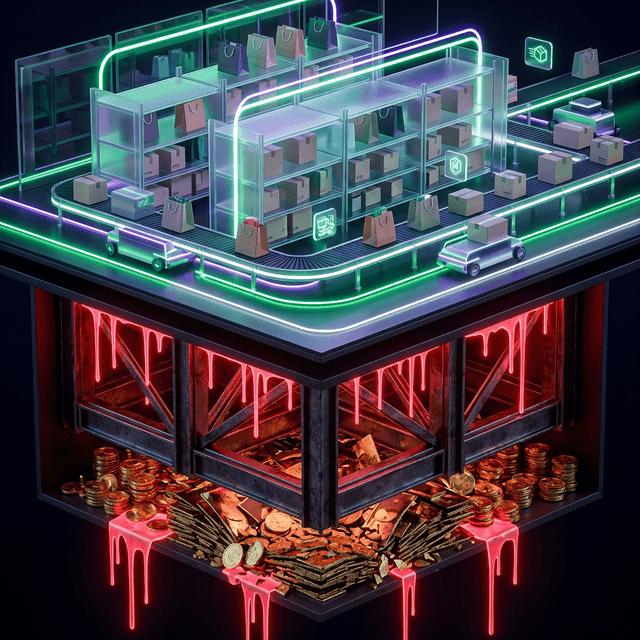
To power this magic, aggregators like Blinkit (Zomato), Zepto, and Swiggy Instamart have built an invisible empire of "Dark Stores"—hyper-local, highly optimized warehouses nested deep within residential neighborhoods. By 2030, India is projected to house over 7,500 of these facilities.
But these glowing neon apps hide a brutal financial reality.
Zomato and Zepto are not using their own venture capital to build physical warehouses. They are overwhelmingly relying on a Franchise-Owned, Franchise-Operated (FOFO) model. They are convincing local entrepreneurs to sink millions of rupees into concrete and inventory, absorbing the entire physical risk while the aggregator controls the digital pipeline.
If you are a high net worth individual or a local businessman considering opening a Blinkit or Zepto dark store in 2026, you need to look past the marketing deck. Here are the brutal unit economics of the quick commerce franchise trap.
1. The Capital Expenditure (CapEx) Bloodbath
The marketing brochures will quietly suggest that becoming a "Growth Partner" is an asset-light way to join the e-commerce boom. The spreadsheet tells a different story.
The Initial Investment (₹30L to ₹60L): Setting up a 2,000 square foot commercial grade warehouse in a high density Tier-1 zone (like Whitefield in Bangalore or Bandra in Mumbai) requires staggering upfront capital.
- •The Franchise Fee: First, you pay a non-refundable onboarding fee of roughly ₹3 Lakhs to ₹5 Lakhs just to access the network.
- •The Real Estate: Commercial landlords require heavy security deposits. You are looking at ₹5 Lakhs to ₹10 Lakhs immediately blocked in a rent agreement.
- •The Infrastructure setup: This is a cold chain warehouse, not an empty room. You must build out massive heavy-duty racking systems, commercial refrigeration units, industrial freezers, power backups, and barcode scanning infrastructure. This easily consumes ₹15 Lakhs to ₹20 Lakhs.
- •The Initial Inventory: You must purchase the first massive wave of stock (groceries, electronics, FMCG goods) out of your own pocket. This requires ₹8 Lakhs to ₹15 Lakhs of pure working capital.
Before you sell a single packet of Maggi, you are down ₹40 Lakhs. You carry the entire asset risk.
2. The Nightmare of Operating Costs (OpEx)
Once the store goes live, the monthly cash burn is relentless.
The Fixed Overheads: Your largest enemy is rent. You must locate the dark store inside a heavily populated, premium residential pin code to ensure standard 10-minute delivery times. Monthly rent in these zones easily hits ₹1.5 Lakhs to ₹2.5 Lakhs.
Then comes the human element. An aggregator app does not pack bags. You must hire a store manager, shift supervisors, and an army of 15 to 20 "pickers and packers." Even at minimum wage, your monthly payroll will exceed ₹3 Lakhs. Add in ₹30,000 for utilities and massive electricity bills to keep the commercial freezers running.
The Royalty Extraction: Here is where the model breaks for the franchisee. After you pay the rent, the electricity, and the staff, the aggregator steps in to take their cut. Depending on the specific contract, aggregators exact a royalty fee ranging from 5% to 10% of the gross monthly revenue, plus ambiguous "technology fees" for using their software.
You are taking 100% of the physical operating risk, but the aggregator taxes your top line before you even calculate your own profit.
3. The 10% Margin Illusion
The primary metric aggressively pushed by platform sales teams is Gross Order Value (GOV). A well-oiled dark store in a busy metro can process ₹40 Lakhs to ₹50 Lakhs of inventory in a single month.
But revenue is vanity; margin is sanity.
Because you are selling fast-moving consumer goods (FMCG) like milk, biscuits, and soap, the gross margins are inherently terrible. Furthermore, you must absorb the cost of expired goods, damaged inventory, and the inevitable "shrinkage" (theft) that occurs when 20 exhausted packers are racing the clock.
After accounting for your brutal fixed costs (rent and salaries) and the aggregator's royalty extraction, your Net Profit Margin on that massive ₹40 Lakh turnover collapses down to roughly 8% to 12%.
If your store moves ₹40 Lakhs of goods, your actual take-home net profit is roughly ₹3.5 Lakhs.
4. The ROI Mathematics
Let us lock in the final calculation.
You invest ₹45 Lakhs to build a premium dark store. It takes 6 to 8 months for the store to reach maturity and consistent order volume. During these initial months, you are burning cash to cover the ₹2 Lakh rent and ₹3 Lakh payroll out of pocket.
Once optimized, the store generates ₹3 Lakhs to ₹4 Lakhs in net profit per month.
Mathematically, your payback period—the time it takes purely to recover your initial capital expenditure—is 18 to 24 months. And that is if everything runs flawlessly. If a competing dark store opens three streets away and steals your order volume, or if warehouse labor costs spike, your payback period stretches rapidly toward three to four years.
By the time you finally break even on the physical infrastructure, the commercial freezers and racking systems will need expensive maintenance or complete replacement, instantly resetting your ROI clock.
The Verdict: Who is Getting Rich?
Zomato and Zepto are engineering a financial masterpiece. They are building a multi-billion dollar national logistics network by using your capital.
If a specific pin-code fails to generate enough orders, the aggregator loses almost nothing. They simply delist the store from the app. You, the franchise partner, are left holding a massive commercial lease, ₹15 Lakhs of depreciating racking equipment, and a warehouse full of expiring milk.
Running a quick commerce dark store is not a passive investment. It is an excruciating, high-stress, low-margin logistical operation. Unless you already own the underlying commercial real estate to eliminate the massive rent overhead, deploying ₹40 Lakhs into a Nifty 50 Index Fund will likely yield a higher, infinitely less stressful return over a five-year horizon.
Frequently Asked Questions
Don't the aggregators pay for the warehouse space?+
How much does a partner actually make per order?+
Are these aggregators finally profitable?+
Sources & References
- [1] Financial statements and Q2 FY26 Earnings Calls of Zepto and ZomatoReferenceVerified: 4 Jun 2026
- [2] Unit Economic Reports on Indian Quick CommerceReferenceVerified: 4 Jun 2026
Disclosure & Update History
This content is for educational purposes only and is not personalized financial, tax, or legal advice.
Update history
- Originally published on 4 June 2026.
- Latest editorial review completed on 4 June 2026.
- Sources cited on this page are reviewed during each editorial refresh.
Tags
Written by Amodh Shetty
Amodh is a personal finance educator and the founder of KnowYourFinance. He focuses on Indian taxation, investing, insurance, and household decision-making frameworks.
Editorial disclosure: The author holds investments in broad-market index funds and SGBs. This article is strictly for educational purposes and does not constitute professional investment advice.
Need Calculators Alongside the Guide?
The article stands on its own. If you want an iPhone companion for running scenarios, saving inputs, and using India-focused calculators, you can use the KnowYourFinance app.
Explore the iPhone App