50/30/20 Budget Rule: Your Path to Financial Balance
The 50/30/20 rule, popularized by Senator Elizabeth Warren, is one of the simplest and most effective budgeting frameworks. Here's how to make it work for Indian households.
What is the 50/30/20 Rule?
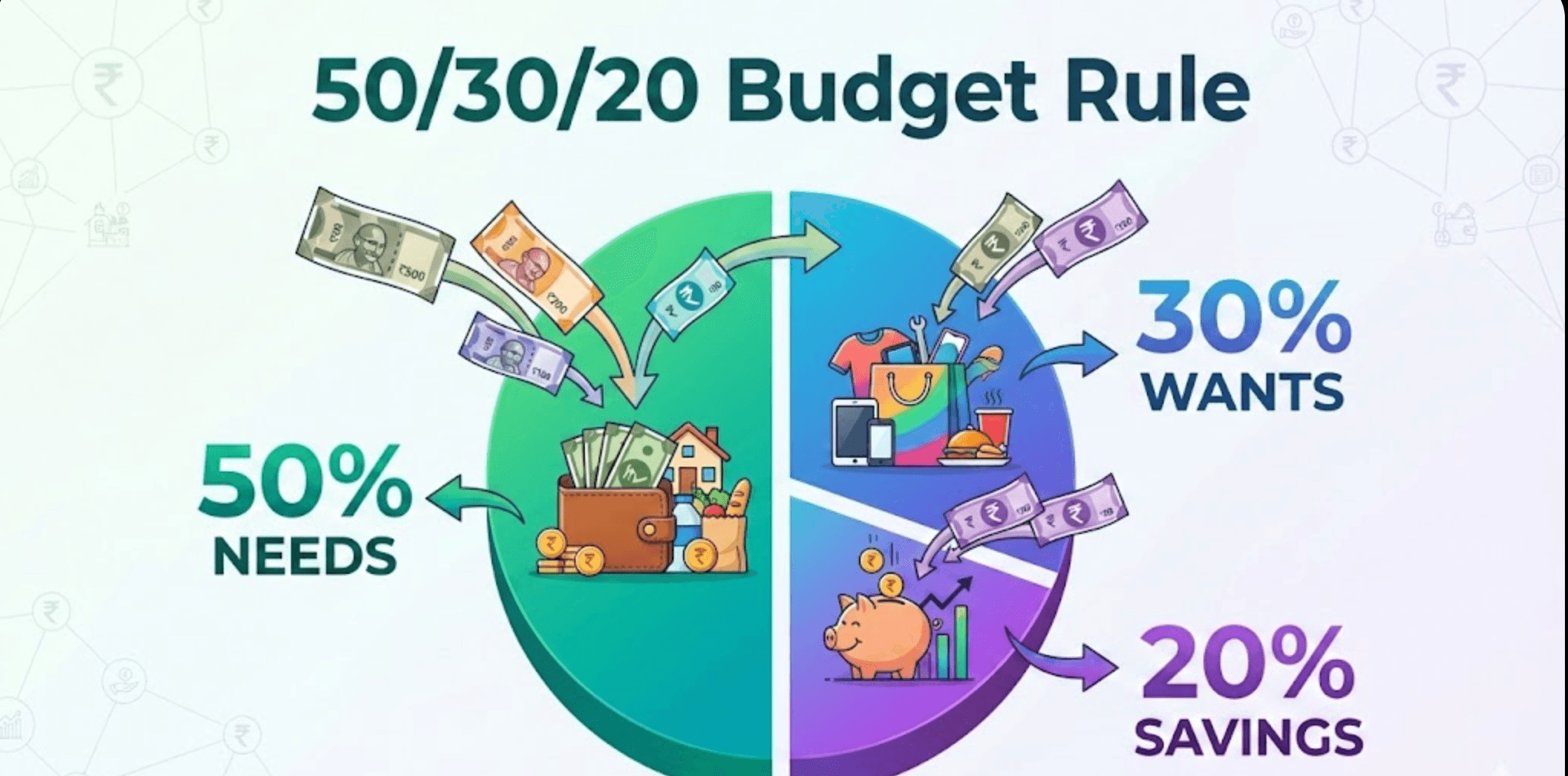
Divide your after-tax income into three categories:
- •50% for Needs - Essential expenses you can't avoid
- •30% for Wants - Lifestyle expenses that improve quality of life
- •20% for Savings - Building wealth and financial security
Understanding Each Category
50% - NEEDS (Essential Expenses)
These are expenses you must pay to survive and function:
| Category | Examples | Typical % of Needs |
|---|---|---|
| Housing | Rent, EMI, maintenance | 35-45% |
| Utilities | Electricity, water, gas, internet | 8-12% |
| Groceries | Food, household supplies | 15-20% |
| Transportation | Fuel, metro, auto, car EMI | 10-15% |
| Insurance | Health, life, vehicle | 5-10% |
| Minimum Debt Payments | Credit card minimum, loan EMIs | Variable |
| Healthcare | Regular medicines, checkups | 3-5% |
Key Rule: If you can survive without it, it's NOT a need.
30% - WANTS (Lifestyle Expenses)
These make life enjoyable but aren't essential:
| Category | Examples |
|---|---|
| Dining Out | Restaurants, cafes, food delivery |
| Entertainment | Movies, concerts, streaming subscriptions |
| Shopping | Clothes, gadgets, home decor |
| Travel | Vacations, weekend trips |
| Hobbies | Gym membership, sports, courses |
| Personal Care | Salon, spa, cosmetics |
| Upgrades | Better phone, car upgrade, premium services |
Key Rule: You could cut these without affecting survival.
20% - SAVINGS & INVESTMENTS
Building your financial future:
| Priority | Category | Examples |
|---|---|---|
| 1 | Emergency Fund | 3-6 months expenses in liquid form |
| 2 | Retirement | EPF, PPF, NPS, retirement MFs |
| 3 | Goals | Child education, house down payment |
| 4 | Investments | SIPs, stocks, FDs |
| 5 | Extra Debt Payment | Paying off loans faster |
50/30/20 Budget Examples
Example 1: Entry-Level Professional (₹50,000/month)
| Category | Amount | Allocation |
|---|---|---|
| NEEDS (50%) | ₹25,000 | |
| Rent | ₹12,000 | |
| Groceries | ₹5,000 | |
| Utilities | ₹2,000 | |
| Transport | ₹3,000 | |
| Insurance | ₹2,000 | |
| Mobile/Internet | ₹1,000 | |
| WANTS (30%) | ₹15,000 | |
| Dining/Entertainment | ₹5,000 | |
| Shopping | ₹4,000 | |
| Subscriptions | ₹1,000 | |
| Personal care | ₹2,000 | |
| Miscellaneous | ₹3,000 | |
| SAVINGS (20%) | ₹10,000 | |
| Emergency Fund | ₹3,000 | |
| SIP | ₹5,000 | |
| PPF | ₹2,000 |
Example 2: Mid-Career Professional (₹1,50,000/month)
| Category | Amount | Allocation |
|---|---|---|
| NEEDS (50%) | ₹75,000 | |
| Home Loan EMI | ₹45,000 | |
| Groceries | ₹12,000 | |
| Utilities | ₹5,000 | |
| Car EMI/Transport | ₹8,000 | |
| Insurance | ₹5,000 | |
| WANTS (30%) | ₹45,000 | |
| Dining/Entertainment | ₹15,000 | |
| Shopping | ₹10,000 | |
| Travel fund | ₹10,000 | |
| Hobbies/Gym | ₹5,000 | |
| Miscellaneous | ₹5,000 | |
| SAVINGS (20%) | ₹30,000 | |
| SIP (Equity) | ₹15,000 | |
| PPF | ₹5,000 | |
| NPS | ₹5,000 | |
| Child Education | ₹5,000 |
Indian Adaptations of 50/30/20
The standard rule may need adjustments for Indian realities:
High-Cost City Variation (60/20/20)
For Mumbai, Delhi, Bangalore where rent is high:
- •60% Needs - Higher housing costs
- •20% Wants - Reduced lifestyle spending
- •20% Savings - Maintain savings rate
Aggressive Saver Variation (50/20/30)
For those targeting FIRE or early goals:
- •50% Needs - Keep essentials same
- •20% Wants - Minimize lifestyle inflation
- •30% Savings - Accelerate wealth building
Single Income Family (60/20/20)
When one spouse manages household:
- •60% Needs - Higher essential costs
- •20% Wants - Balanced lifestyle
- •20% Savings - Protect family's future
Debt Payoff Mode (50/20/30)
When paying off high-interest debt:
- •50% Needs - Including minimum payments
- •20% Wants - Temporary sacrifice
- •30% Savings/Debt - Aggressive debt payoff
Budget by Income Level
| Monthly Income | Needs | Wants | Savings |
|---|---|---|---|
| ₹30,000 | ₹15,000 | ₹9,000 | ₹6,000 |
| ₹50,000 | ₹25,000 | ₹15,000 | ₹10,000 |
| ₹75,000 | ₹37,500 | ₹22,500 | ₹15,000 |
| ₹1,00,000 | ₹50,000 | ₹30,000 | ₹20,000 |
| ₹1,50,000 | ₹75,000 | ₹45,000 | ₹30,000 |
| ₹2,00,000 | ₹1,00,000 | ₹60,000 | ₹40,000 |
Common Budgeting Mistakes
- •
Misclassifying Wants as Needs
- •Premium gym ≠ Need (basic exercise is free)
- •Latest iPhone ≠ Need (functional phone is)
- •Dining out ≠ Need (home cooking is)
- •
Ignoring Irregular Expenses
- •Annual insurance premiums
- •Festival expenses
- •Vehicle maintenance
- •Medical emergencies
- •
Not Adjusting for Life Changes
- •Marriage, children, job change
- •Review budget every 6 months
- •
Lifestyle Inflation
- •Salary increase ≠ Spending increase
- •Increase savings rate with income
How to Implement 50/30/20
Step 1: Calculate After-Tax Income
- •Salary - TDS - Professional Tax = Take-home
Step 2: Track Current Spending
- •Use apps or spreadsheets for 1-2 months
- •Categorize every expense
Step 3: Identify Gaps
- •Compare current vs 50/30/20 allocation
- •Find areas to cut or reallocate
Step 4: Automate Savings
- •Set up SIPs on salary day
- •Auto-transfer to savings account
Step 5: Review Monthly
- •Track adherence
- •Adjust as needed
50/30/20 vs Other Budgeting Methods
| Method | Best For | Complexity |
|---|---|---|
| 50/30/20 | Beginners, balanced approach | Low |
| Zero-Based | Detail-oriented, debt payoff | High |
| Envelope System | Cash users, overspenders | Medium |
| Pay Yourself First | Savings-focused | Low |
| 80/20 | Simplicity lovers | Very Low |
When 50/30/20 Doesn't Work
Consider alternatives if:
- •Needs exceed 50% (high debt, expensive city)
- •Income is irregular (freelancers, business owners)
- •Specific aggressive goals (FIRE, debt payoff)
- •Very high or very low income
Track your budget effortlessly with KnowYourFinance app's expense tracker and financial health score!
Frequently Asked Questions
Does 50/30/20 work for every Indian household?+
Should EMI go under needs or savings?+
What if I cannot save 20% yet?+
Sources & References
- [1] NSSO Household Expenditure SurveyReferenceVerified: 15 Dec 2025
- [2] RBI Savings DataRegulatorVerified: 15 Dec 2025
Disclosure & Update History
This content is for educational purposes only and is not personalized financial, tax, or legal advice.
Update history
- Originally published on 15 December 2025.
- Latest editorial review completed on 15 December 2025.
- Sources cited on this page are reviewed during each editorial refresh.
Tags
Written by Amodh Shetty
Amodh is a personal finance educator and the founder of KnowYourFinance. He focuses on Indian taxation, investing, insurance, and household decision-making frameworks.
Editorial disclosure: The author holds investments in broad-market index funds and SGBs. This article is strictly for educational purposes and does not constitute professional investment advice.
Need Calculators Alongside the Guide?
The article stands on its own. If you want an iPhone companion for running scenarios, saving inputs, and using India-focused calculators, you can use the KnowYourFinance app.
Explore the iPhone App