Five years ago, managing debt was simple. If you wanted to buy something you didn't have cash for, you swiped a credit card. If you didn't have a credit card, you saved up.
Today, the landscape has completely exploded. You open Swiggy, and "LazyPay" offers you one-click checkout. You open Amazon, and "Amazon Pay Later" offers to split your bill. You open your UPI app at a local tea stall, and your bank prompts you to use your "Credit Line on UPI."
Suddenly, your phone is offering you three different ways to spend money you don't have yet. For young professionals in the 18-40 age bracket, this is a dangerous tightrope. If managed well, it’s a financial superpower. If managed poorly, it’s a fast track to a ruined CIBIL score.
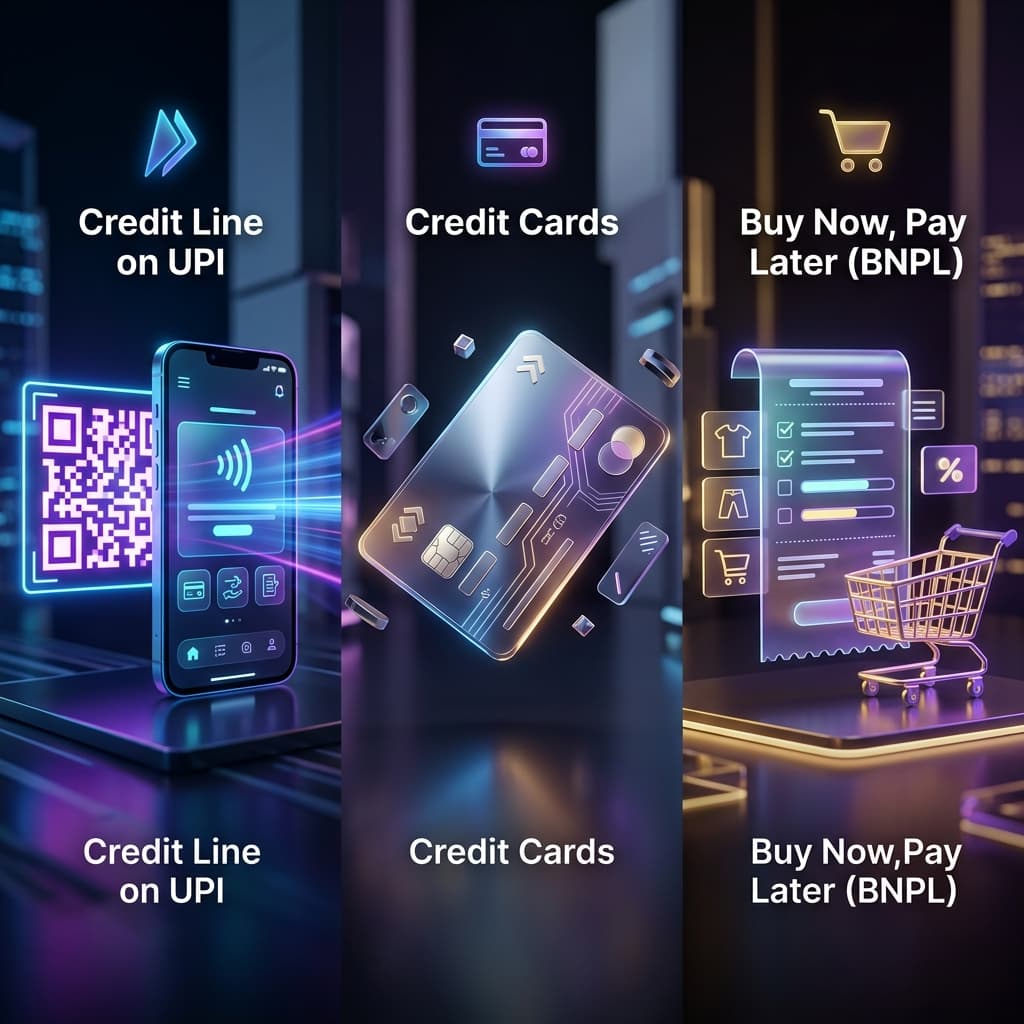
Let's break down the exact differences between Credit Cards, BNPL, and Credit Line on UPI, and introduce a simple system to manage them: The C.U.B. Framework.
1. Credit Cards: The Traditional Heavyweight
Credit cards are the oldest and most powerful form of digital credit. Issued by major banks, they offer a revolving credit line with a 30-45 day interest-free period.
- •The Superpower: Rewards and global acceptance. Credit cards are designed for premium experiences. They offer airport lounge access, massive air-mile multipliers, and flat 10% discounts during festive sales. Furthermore, they are the gold standard for building a long-term CIBIL score.
- •The Weakness: High barrier to entry. Banks require a strong credit history and proof of income. Also, they are practically useless at your local kirana store or vegetable vendor, who only accepts UPI.
- •The Trap: If you miss a payment, credit cards charge exorbitant interest rates (up to 40%+ annually), trapping you in a compounding debt cycle.
2. Buy Now, Pay Later (BNPL): The Quick Fix
BNPL is a product championed by fintech startups. It allows you to check out online instantly and pay the bill 15 to 30 days later, usually with zero interest.
- •The Superpower: Frictionless checkout. You don't need to wait for OTPs or enter CVVs. It is a seamless 1-click experience designed for impulse purchases on food delivery apps and e-commerce sites. Approval is almost instant, requiring minimal documentation.
- •The Weakness: It is highly restricted. You can only use it at partner merchants. You cannot use "Simpl" or "LazyPay" at an offline grocery store.
- •The Trap: It feels like "fake money." Because the checkout is so smooth, it encourages overspending. Additionally, missing a BNPL payment often results in brutal, flat-rate late fees that can quickly exceed the value of the original purchase.
3. Credit Line on UPI: The Daily Driver
This is the RBI’s masterstroke. It bridges the gap between the ubiquity of UPI and the power of bank credit. Your bank pre-approves a credit limit (e.g., ₹50,000) and links it directly to your BHIM, GPay, or PhonePe app. 1
- •The Superpower: Ultimate Acceptance. You can scan any merchant QR code—from the local barber to a high-end restaurant—and pay using credit. You get the 45-day interest-free period of a credit card without needing the physical plastic or a swipe machine.
- •The Weakness: It is restricted to merchant payments (P2M). You cannot transfer money to a friend (P2P). Also, the reward structures are currently not as lucrative as premium credit cards.
- •The Trap: Because it feels exactly like a normal UPI transaction from your savings account, you can easily lose track of the fact that you are spending borrowed money on daily groceries.
The Simple System: The C.U.B. Framework
Having three credit options is confusing. To ensure you maximize rewards while protecting your financial health, use the C.U.B. Framework. Memorize what each tool is built for, and never mix them up.
C - Credit Card (The Heavyweight)
Use it for: Planned, High-Value, and Global Spends. If you are buying a laptop, booking international flights, paying a large hospital bill, or shopping during the Amazon Great Indian Festival, use a Credit Card. You want the buyer protection, the EMI conversion options, and the heavy reward points. Rule: Never use a credit card to withdraw cash.
U - UPI Credit Line (The Daily Driver)
Use it for: Everyday Local Spends. If you are buying groceries at the local supermarket, paying the neighborhood pharmacy, or covering dinner at a local restaurant that doesn't accept cards, use your UPI Credit Line. It allows you to keep your savings account untouched and earning interest while you use bank money for daily cash flow. Rule: Treat this like cash. Only spend what you have sitting in your savings account ready to clear the bill.
B - BNPL (The Quick Fix)
Use it for: Small, Occasional Online Checkouts. If you are ordering a ₹300 Swiggy meal and your hands are full, the 1-click checkout of BNPL is a lifesaver. It is built for absolute convenience. Rule: Never use BNPL as a way to afford something you don't have the money for. Set your BNPL apps to auto-debit the full amount from your bank account every 15 days so you never incur a late fee.
The Ultimate Verdict
For a young professional aiming for financial mastery, you do not need 5 credit cards and 3 BNPL apps. That is a recipe for disaster and a fragmented CIBIL report.
The optimal setup for 2026 is simple: One premium Credit Card (for your big purchases and travel) paired with One Credit Line on UPI from your primary bank (for your daily offline spending).
This combination gives you 100% market acceptance, maximizes your rewards, and keeps your debt centralized in two easily manageable bills. Master the C.U.B. framework, and make the digital credit ecosystem work for you, not against you.
Frequently Asked Questions
Does using a Credit Line on UPI impact my CIBIL score?+
Can I transfer money to a friend using my UPI Credit Line?+
Is BNPL better than a Credit Card for Amazon/Flipkart sales?+
Sources & References
- [1] Reserve Bank of India - Operation of Pre-Sanctioned Credit Lines at Banks through UPIRegulatorUsed for: UPI-linked pre-sanctioned credit line rulesVerified: 16 May 2026
Disclosure & Update History
This content is for educational purposes only and is not personalized financial, tax, or legal advice.
Update history
- Originally published on 16 May 2026.
- Latest editorial review completed on 16 May 2026.
- Sources cited on this page are reviewed during each editorial refresh.
Tags
Written by Amodh Shetty
Amodh is a personal finance educator and the founder of KnowYourFinance. He focuses on Indian taxation, investing, insurance, and household decision-making frameworks.
Editorial disclosure: The author holds investments in broad-market index funds and SGBs. This article is strictly for educational purposes and does not constitute professional investment advice.
Need Calculators Alongside the Guide?
The article stands on its own. If you want an iPhone companion for running scenarios, saving inputs, and using India-focused calculators, you can use the KnowYourFinance app.
Explore the iPhone App