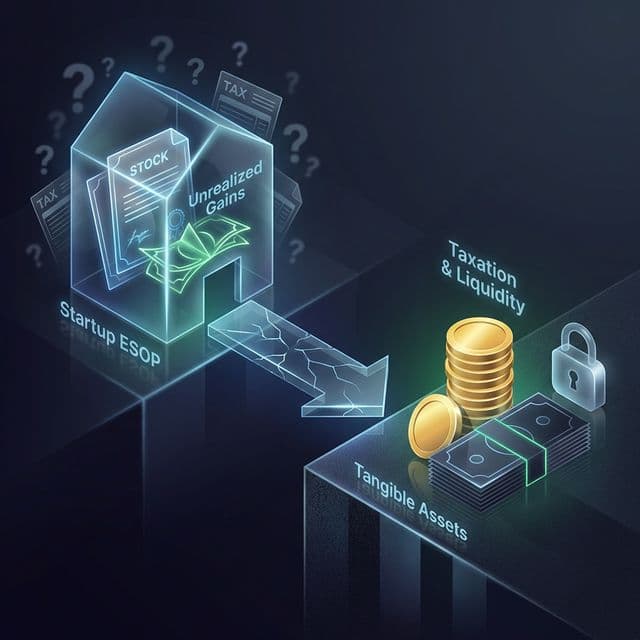
The ₹1 Crore Offer Letter
You are a brilliant software engineer. You get two job offers.
Offer A (The Boring Corporate): ₹50 Lakhs cash component per year. Offer B (The Hot AI Startup): ₹30 Lakhs cash component + ₹80 Lakhs worth of ESOPs vested over 4 years.
HR at the startup tells you: "We are growing 3x year-on-year. By the time your options vest, this ₹80 Lakhs will easily be worth ₹3 Crores. You are basically getting a multi-crore package. Welcome to the rocket ship."
You take Offer B. You work 80-hour weeks. You build the core product. You bleed for the company. You drink the startup Kool-Aid.
Four years pass. The company is now a unicorn. Your ESOPs are fully vested. On paper, your dashboard says your shares are worth ₹3 Crores. You feel rich. You start looking at luxury apartments on weekends. You are officially part of the 1%.
Then, you decide it's time to move on to your next adventure. You resign. HR hands you an exit document. It says: "You have 90 days to exercise your vested options, otherwise they will lapse and return to the ESOP pool."
You smile. "Of course I will exercise them. I am not leaving ₹3 Crores on the table."
Then your CA calls you. And your world shatters.
Your CA explains that to "exercise" and keep these shares, you must pay the startup your exercise price (say, ₹10 Lakhs). But worse, the Income Tax Department considers this a "salary bonus." You now owe the government ₹1 Crore in taxes. OUT OF POCKET. TODAY. Even though you haven't sold a single share. Even though you haven't seen a single rupee of real cash.
Welcome to the brutal reality of Startup ESOP Taxation in India. It is the ultimate destroyer of paper millionaires.
Let's break down the First Principles of ESOPs, how the tax trap works, and how you can protect yourself.
Part 1: First Principles, What exactly are ESOPs?
Before we talk about the tax trap, we need to understand what an ESOP (Employee Stock Option Plan) actually is.
When a startup gives you ESOPs, they are NOT giving you shares. They are giving you an OPTION to buy shares in the future, at a fixed, heavily discounted price.
There are four phases to the ESOP lifecycle. If you do not understand these four phases, you are playing a high-stakes poker game without knowing the rules.
1. Grant
This is the day you sign the offer letter. The company "grants" you, say, 10,000 ESOPs. At this point, you own nothing. You just have a promise on a piece of paper. Tax Impact: Zero.
2. Vesting
Vesting is the waiting period. The company says: "You get these options ONLY if you stay with us." Usually, startups in India follow a 4-year vesting schedule with a 1-year "Cliff".
- •The Cliff: If you leave before 1 year, you get 0 ESOPs. You walk away with nothing.
- •Vesting: After year 1, usually 25% of your options "vest" (become yours to buy). Then they vest monthly or yearly after that. Tax Impact: Zero.
3. Exercise (The Danger Zone)
Once options have vested, they are yours to "buy". To buy them, you must pay the company the Strike Price (or Exercise Price). Let's say your Strike Price is ₹10 per share. To buy your 10,000 vested options, you must wire ₹1,00,000 to the startup's bank account. Once you pay this, congratulations! You are officially a shareholder. You own equity. Tax Impact: Massive. This triggers Perquisite Tax.
4. Sale (Liquidity Event)
This is when you turn your paper equity into real cash in your bank account. This happens during an IPO, a buyback by the founders, or if the company gets acquired. Tax Impact: Triggers Capital Gains Tax.
The horror stories you hear about ESOPs almost entirely revolve around Phase 3: Exercise. Let's look at why.
Part 2: The First Tax Trap, "The Exercise Penalty"
Here is the fundamental flaw in how the Indian Income Tax Department views startup ESOPs.
The government treats ESOPs as a "Perquisite" (a fringe benefit or bonus) given to you by your employer. They tax it as Salary Income.
But how do they calculate how much "bonus" you received? They look at the difference between the Fair Market Value (FMV) of the shares today, and the Strike Price you paid for them.
Let's go back to our 100x Developer example to see the math in action.
The Math of Ruin:
- •You decide to leave the startup after 4 years.
- •You have 10,000 vested options.
- •The Strike Price you must pay the company is ₹100 per share.
- •Because the startup became a unicorn, the Fair Market Value (FMV) of the shares today is ₹3,100 per share.
Step 1: You must pay to buy the shares. 10,000 shares x ₹100 = ₹10 Lakhs. You must transfer ₹10 Lakhs from your savings account to the startup. This is painful, but manageable. You are buying ₹3 Crores of value for ₹10 Lakhs.
Step 2: The Perquisite Tax is calculated. The Income Tax Department says: "Wow! You bought an asset worth ₹3,100 for just ₹100. Your company gave you a discount of ₹3,000 per share. That discount is your salary bonus!"
Perquisite Value: 10,000 shares x ₹3,000 discount = ₹3 Crores.
The government adds ₹3 Crores to your taxable salary for the year. Because you are now in the highest tax bracket (plus massive surcharges), your effective tax rate is around 39%.
Tax Owed: 39% of ₹3 Crores = ₹1.17 Crores.
Step 3: The Brutal Reality The startup is obligated by law to deduct this tax at source (TDS). HR calls you: "Hey, before we give you your shares, please deposit ₹1.17 Crores with us so we can pay your TDS to the government."
Total Outflow to get your ESOPs:
- •Exercise Price: ₹10 Lakhs
- •Perquisite Tax (TDS): ₹1.17 Crores
- •Total Cash Leaving Your Bank Account: ₹1.27 Crores.
Total Inflow:
- •Zero Rupees. You just got an entry in a digital cap table saying you own shares.
You must pay ₹1.27 Crores in real, hard-earned cash to the government in exchange for "Paper Wealth" that you cannot sell! Because the startup is unlisted, you cannot open a Zerodha account and sell these shares. They are illiquid. You have to wait for an IPO or a buyback, which might not happen for years, or might never happen at all.
This is why startup employees call it "The Golden Handcuffs."
Part 3: The 30% Tax Trap - Why "Loyalty" is Forced
Let's say you don't have ₹1.27 Crores sitting in your savings account. Most people don't. What are your choices when you want to resign?
Choice 1: Let the Options Lapse.
You simply say, "I can't afford the tax. I won't exercise." Your 90-day window expires. The 10,000 options return to the ESOP pool. You just worked 80-hour weeks for 4 years, built a unicorn, and walked away with absolutely nothing. You forfeited ₹3 Crores.
Choice 2: Beg for a Cash Loan.
You run to banks asking for a personal loan of ₹1.27 Crores. Banks laugh at you because unlisted startup shares are not acceptable collateral for a loan. You borrow from family, friends, or high-interest shadow lenders, taking on massive ruinous debt for illiquid shares.
Choice 3: The "Loyalty" Trap (Don't Resign).
This is what 95% of startup employees do. You stay. You don't resign. As long as you remain an employee of the startup, you do not have to exercise your vested options. You can just let them sit there, fully vested, indefinitely. You don't trigger the tax event because you haven't bought the shares yet.
You are now a hostage. You cannot take the better job offer from Google. You cannot start your own company. You are chained to your desk, praying every night that the founder announces an IPO or a cash buyback.
Your entire net worth is tied up in a company you want to leave, but can't, because the tax code makes it mathematically impossible to exit gracefully.
Part 4: The Second Tax Trap, Capital Gains on Sale
Let's assume the happy path. You somehow paid the ₹1.27 Crores tax. You own the shares. Three years later, the heavens open. The startup announces an IPO! The company lists on the stock market. The share price skyrockets to ₹5,100 per share.
You finally sell your 10,000 shares! Total Cash Inflow: 10,000 x ₹5,100 = ₹5.1 Crores.
You are rich! Right? Not so fast. The government is back.
You now have to pay Capital Gains Tax.
How Capital Gains are calculated:
- •Sale Price: ₹5,100
- •Cost of Acquisition: The government is actually somewhat fair here. Your cost of acquisition is NOT the ₹100 strike price you paid. It is the ₹3,100 FMV on which you already paid perquisite tax. (They don't double-tax you on the same gain).
- •Capital Gain per share: ₹5,100 - ₹3,100 = ₹2,000.
- •Total Capital Gain: 10,000 shares x ₹2,000 = ₹2 Crores.
What is the tax rate? Since these were unlisted shares when you got them, and you held them for more than 2 years, it falls under Long Term Capital Gains (LTCG) for Unlisted Shares. Tax Rate: 12.5% (Without Indexation, as per the new 2024 Budget rules).
LTCG Tax Owed: 12.5% of ₹2 Crores = ₹25 Lakhs.
The Final Post-Mortem
Let's look at the entire lifecycle of your "₹5 Crore" ESOP windfall:
- •Gross Value Sold: ₹5.10 Crores
- •Minus Exercise Price: - ₹0.10 Crores
- •Minus Perquisite Tax Paid: - ₹1.17 Crores
- •Minus Capital Gains Tax: - ₹0.25 Crores
- •Net Money In Your Pocket: ₹3.58 Crores.
The government took almost ₹1.42 Crores in taxes across two different events. Your effective tax rate on your startup wealth was nearly 30%. And remember, you carried all the risk. If the startup went to zero before the IPO, the government wouldn't give you a refund for the ₹1.17 Crore Perquisite tax you paid.
Part 5: The "DPIIT Exemption" Illusion
Startup founders love to say: "Don't worry about the exercise tax! We are a DPIIT recognized startup under the Startup India scheme. We have Section 80-IAC exemption!"
What is Section 80-IAC? It is a tax holiday introduced by the government to solve exactly this "phantom tax" problem. If your startup has this exemption, you DO NOT have to pay the Perquisite Tax immediately when you exercise your options.
The tax deduction is deferred (postponed) to whichever of these three events happens FIRST:
- •48 months from the end of the assessment year in which you exercised.
- •The date you sell the shares.
- •The date you resign from the company.
Why it is an illusion: Look closely at condition #3. "The date you resign from the company." The moment you quit, the tax becomes due immediately. The 80-IAC exemption does absolutely nothing to solve the "Golden Handcuffs" hostage situation. You still cannot leave the company without triggering the massive cash outflow.
Furthermore, out of the 1,00,000+ startups in India, only a tiny fraction (around 1%) actually hold the coveted Section 80-IAC certificate. Just being "DPIIT Registered" is not enough. The startup must have cleared the rigid Inter-Ministerial Board (IMB) certification for 80-IAC. Most startups lie or are ignorant about this distinction.
Part 6: How to Protect Yourself (The ESOP Playbook)
If you are joining a startup and taking a massive pay cut for ESOPs, you need to negotiate aggressively. Here is your playbook.
1. Negotiate an Extended Exercise Window
Standard ESOP policies give you 30 to 90 days to exercise your options after you resign. This is predatory. The best startups in the world (like Amplitude, Pinterest, and increasingly top Indian unicorns) now offer a 7-year or 10-year exercise window.
If you have a 10-year window, you can resign today, let your vested options sit safely without exercising them, wait for the IPO to happen 5 years later, and only exercise during the IPO when you can immediately sell the shares to cover the tax. You never go out of pocket. Ask HR: "What is the post-termination exercise period? Will you extend it to 5 years?"
2. Exercise Early (When FMV is zero)
If you join an early-stage seed-funded startup, the FMV of the shares is virtually zero. The valuation is low. If the company policy allows it, exercise your options immediately as they vest, every single month. Because the FMV is close to your Strike Price, the perquisite tax is almost zero. By the time the company becomes a unicorn, you already own the shares, tax-free. You only pay Capital Gains when you sell. Warning: You still take the risk of losing your small exercise price if the startup dies.
3. Negotiate Cash over Equity later in the cycle
If you join a Series C or Series D late-stage startup, the FMV is already astronomically high. Your perquisite tax bill will be devastating. At this stage, ESOPs have terrible risk/reward math. Optimize strictly for cash compensation. The golden era of ESOP wealth creation happens at Seed or Series A stages.
4. Demand Secondary Sales / Buybacks
Before joining, ask: "When was the last time founders conducted an ESOP buyback for employees? What is the frequency?" Great startups don't force employees to wait for an IPO. Whenever they raise a new funding round from VCs, they carve out 10% of the round to buy back ESOPs from early employees. This provides liquidity so employees can actually enjoy their hard work without resigning.
The Verdict
Startup ESOPs are not a scam. They have genuinely created immense wealth and birthed entire entire ecosystems of angel investors (just look at Flipkart, Freshworks, and Zomato employees).
However, ESOPs are a High-Risk Financial Instrument wrapped in complex tax law.
Treat paper wealth with extreme skepticism. Until the money clears your bank account post-tax, you are not rich. You just hold a lottery ticket that the government intends to tax heavily.
Do not take a 50% pay cut on your base salary believing the ESOP fairy will make you a millionaire, unless you have read the ESOP policy document line-by-line, understand the exit window, and have verified the company's buyback history.
Real cash builds your emergency fund today. Paper wealth might buy you a villa in a decade. Allocate your career capital accordingly.
Frequently Asked Questions
When do I actually pay tax on ESOPs?+
What if the startup goes bankrupt after I paid the exercise tax?+
Is there any tax exemption for ESOPs?+
Sources & References
- [1] Income Tax Department - Taxation of ESOPsTax AuthorityVerified: 21 Feb 2026
Disclosure & Update History
This content is for educational purposes only and is not personalized financial, tax, or legal advice.
Update history
- Originally published on 22 February 2026.
- Latest editorial review completed on 21 February 2026.
- Sources cited on this page are reviewed during each editorial refresh.
Tags
Written by Amodh Shetty
Amodh is a personal finance educator and the founder of KnowYourFinance. He focuses on Indian taxation, investing, insurance, and household decision-making frameworks.
Editorial disclosure: The author holds investments in broad-market index funds and SGBs. This article is strictly for educational purposes and does not constitute professional investment advice.
Need Calculators Alongside the Guide?
The article stands on its own. If you want an iPhone companion for running scenarios, saving inputs, and using India-focused calculators, you can use the KnowYourFinance app.
Explore the iPhone App