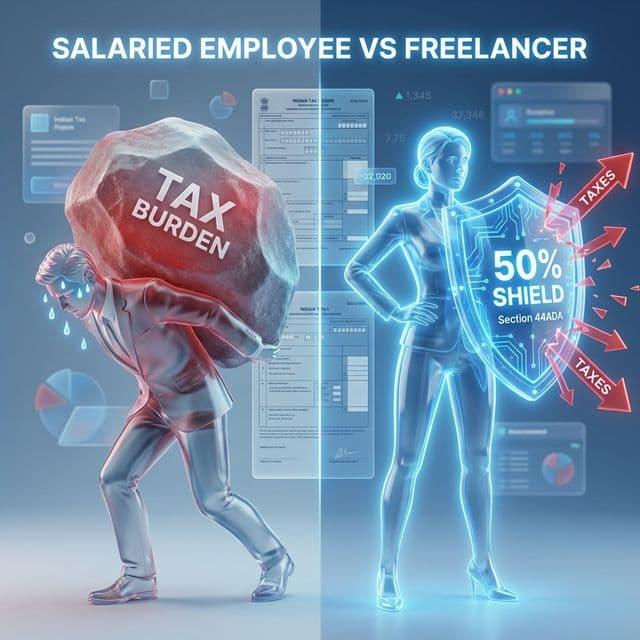
A client pays ₹14 lakh. You hear that freelancers can declare half and pay no tax. Before changing a salary arrangement or filing a return, check the sentence that social-media advice leaves out: only if the relevant scheme actually applies to you.
Check your work and legal status
The professional presumptive scheme commonly called section 44ADA covers specified professions. Examples include legal, medical, engineering, architecture, accountancy and specified technical or notified professions. Calling yourself a freelancer, creator or consultant does not automatically qualify the activity.
The old provision applies to eligible resident individuals and partnership firms other than LLPs. A company, LLP, non-resident or an ineligible activity cannot simply choose it because the tax calculation looks attractive.
Understand the receipts ceiling
The usual gross-receipts ceiling is ₹50 lakh. The enhanced ₹75 lakh limit requires cash receipts not exceeding 5% of gross receipts. Relevant non-account-payee receipts are treated as cash for this test.
This is gross professional receipts, not profit after expenses. Keep invoices and receipt records sufficient to establish the amount and payment modes.
What the 50% computation does
For the professional scheme, the prescribed amount is 50% of gross receipts or the higher profit claimed as actually earned. It is not permission to hide receipts, invent expenses or misdescribe salary as professional income.
Qualifying presumptive computation reduces the need to substantiate individual expense deductions. You do not then deduct the same laptop, rent, depreciation or car lease again from that presumptive income. Lower-profit declarations can bring books and audit requirements into play, depending on the statutory conditions.
Even where detailed expense books are not required by the scheme, retain contracts, invoices, bank statements, tax credits and the eligibility working. 'Simpler compliance' is not 'no records'.
The law changed its numbering
FY 2025–26 returns remain under the Income-tax Act 1961. For income from 1 April 2026, section 58 of the Income-tax Act 2025 consolidates the relevant resident presumptive computations. The current section expressly sets out the profession, receipt limits and higher-profit computation. Use the right tax-year forms.
Compare take-home money fairly
A ₹14 lakh salary and ₹14 lakh professional receipts are not equivalent packages. The freelancer may pay equipment costs, insurance, leave, employer-equivalent retirement savings and periods without work. Salary also has its own deduction rules.
For an illustration, ₹14 lakh of eligible professional receipts has a ₹7 lakh 50% computation before considering the higher-profit provision and the rest of the person's return. Whether any tax remains depends on residence, regime, other income and applicable rebates. It is not a universal zero-tax promise.
Finally, GST, TDS and advance tax are separate checks. Choosing presumptive income tax does not switch them off.
Frequently Asked Questions
Can every person with a side hustle use this scheme?+
Can I claim car depreciation after declaring presumptive professional income?+
Sources & References
- [1] Income-tax Act 2025: section 58OfficialUsed for: Corrected universal freelancer eligibility, unconditional ₹75 lakh ceiling and misleading salary-versus-freelance tax claims.Verified: 23 Oct 2026
- [2] Income Tax Department: professional presumptive taxationOfficialUsed for: Corrected universal freelancer eligibility, unconditional ₹75 lakh ceiling and misleading salary-versus-freelance tax claims.Verified: 23 Oct 2026
- [3] Income Tax Department: transition and formsOfficialUsed for: Corrected universal freelancer eligibility, unconditional ₹75 lakh ceiling and misleading salary-versus-freelance tax claims.Verified: 23 Oct 2026
Disclosure & Update History
This content is for educational purposes only and is not personalized financial, tax, or legal advice.
Update history
- Originally published on 10 February 2026.
- Updated 23 October 2026: Corrected universal freelancer eligibility, unconditional ₹75 lakh ceiling and misleading salary-versus-freelance tax claims.Rules effective: 1 April 2026.
- Latest editorial review completed on 23 October 2026.
- Sources cited on this page are reviewed during each editorial refresh.
Tags
Written by Amodh Shetty
Amodh is a personal finance educator and the founder of KnowYourFinance. He focuses on Indian taxation, investing, insurance, and household decision-making frameworks.
Editorial disclosure: The author holds investments in broad-market index funds and SGBs. This article is strictly for educational purposes and does not constitute professional investment advice.
Need Calculators Alongside the Guide?
The article stands on its own. If you want an iPhone companion for running scenarios, saving inputs, and using India-focused calculators, you can use the KnowYourFinance app.
Explore the iPhone App