No-cost EMI sounds self-explanatory, which is why many buyers stop thinking once they see the label.
The better way to read it is this: the seller or lender has structured the cost so that the offer can be marketed as low-friction monthly payments. Your job is to figure out whether that structure is genuinely harmless or merely well packaged.
How these offers usually work
Many no-cost EMI offers are not magic. They are often forms of merchant subvention.
In plain language:
- •the bank still has an EMI structure
- •some part of the financing cost may be absorbed by the merchant or reflected in discounting
- •the customer sees a monthly payment that looks simple and appealing
That is why RBI's disclosure framework around APR and Most Important Terms and Conditions matters. The cost of credit should be understandable, not hidden behind marketing language.
The comparison most buyers miss
The right question is not:
"Can I convert this into EMI?"
The right question is:
"What is my final rupee outgo under EMI compared with the best upfront price available today?"
A worked example
Suppose a phone is listed at ₹50,000 under a no-cost EMI offer.
You also discover that paying up front with a different card or bank offer brings the effective immediate-payment price down to ₹46,000.
Now assume the EMI route adds:
- •processing fee: ₹199
- •GST on the processing fee and any billed financing component
- •other issuer-specific charges, if applicable
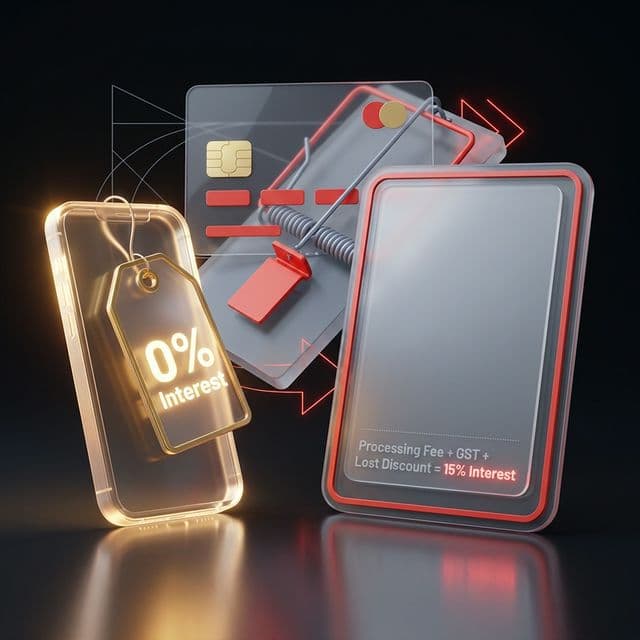
Even if the headline EMI looks equal to the listed product price, the EMI route may still cost more once charges and missed discount are counted.
If your total outgo under EMI becomes, say, ₹50,600, then you are not comparing "free loan" versus "cash." You are comparing ₹50,600 versus ₹46,000.
That is a very different decision.
Where buyers go wrong
Mistake 1: comparing EMI to MRP instead of to the real cash price
The price that matters is the best price you could actually obtain immediately, not the banner price shown next to the EMI badge.
Mistake 2: ignoring charges outside the headline EMI
Processing fee is the most common one. Depending on issuer structure, GST may apply on relevant fee or financing components shown on the statement.
Mistake 3: using EMI to make an impulsive purchase feel affordable
Sometimes the biggest cost is not APR. It is the fact that EMI lowers the psychological pain of buying something you did not need urgently.
When no-cost EMI can still make sense
It is not always a trap.
It can be reasonable when:
- •the upfront price and EMI-adjusted price are genuinely similar
- •processing costs are minimal
- •you value liquidity and want to spread cash flow
- •you would have kept the money in a productive use instead of just letting it sit idle
When paying up front is usually better
Paying up front tends to win when:
- •you get a meaningful immediate-payment discount
- •the lender adds noticeable processing cost
- •the EMI tenure is short enough that the monthly convenience is not worth the higher total outgo
- •you are stretching to buy a discretionary item
A simple decision formula
Before choosing EMI, write down:
- •best immediate-payment price
- •total of all EMI instalments
- •processing fee
- •GST or other extra issuer charges, if any
- •any cashback or discount forgone by choosing EMI
Then compare the final numbers, not the labels.
The practical takeaway
No-cost EMI is not a financial category. It is a marketing presentation of a financing arrangement.
If the EMI route protects cash flow without raising total cost much, it can be fine. If it quietly turns a ₹46,000 purchase into a ₹50,000-plus outgo, the convenience is expensive.
Frequently Asked Questions
Is no-cost EMI truly free?+
When can no-cost EMI be useful?+
What should I check before choosing EMI?+
Sources & References
- [1] RBI - Credit Card and Debit Card DirectionsRegulatorVerified: 4 Jun 2026
- [2] RBI - APR and MITC disclosure requirementsRegulatorVerified: 4 Jun 2026
Disclosure & Update History
This content is for educational purposes only and is not personalized financial, tax, or legal advice.
Update history
- Originally published on 17 February 2026.
- Latest editorial review completed on 4 June 2026.
- Sources cited on this page are reviewed during each editorial refresh.
Tags
Written by Amodh Shetty
Amodh is a personal finance educator and the founder of KnowYourFinance. He focuses on Indian taxation, investing, insurance, and household decision-making frameworks.
Editorial disclosure: The author holds investments in broad-market index funds and SGBs. This article is strictly for educational purposes and does not constitute professional investment advice.
Need Calculators Alongside the Guide?
The article stands on its own. If you want an iPhone companion for running scenarios, saving inputs, and using India-focused calculators, you can use the KnowYourFinance app.
Explore the iPhone App