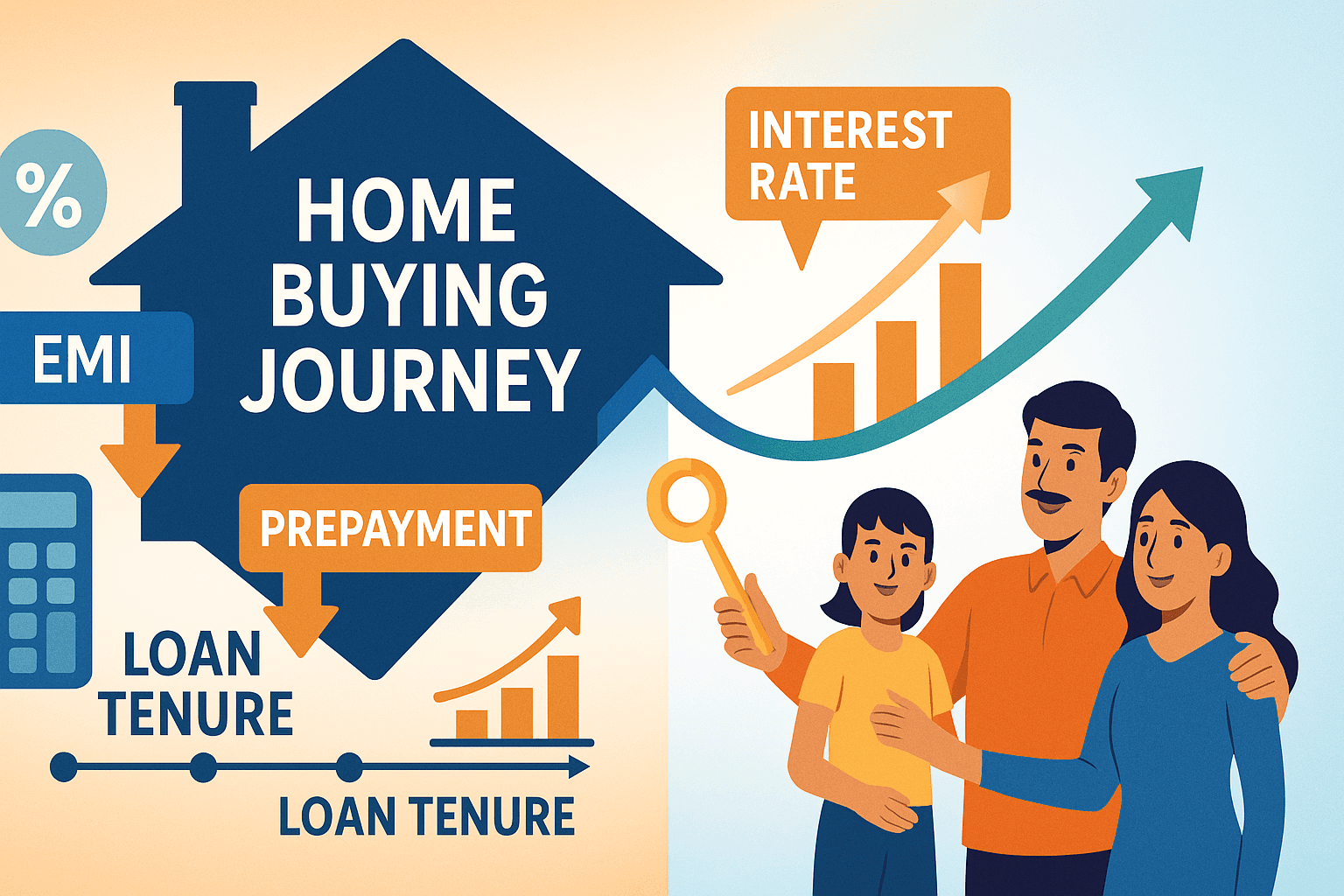
The EMI on a home loan looks stable and manageable because it is shown as one monthly number. What that number hides is how slowly the principal falls in the early years.
That is why small prepayments can matter more than many borrowers expect.
Start With One Base Case
Assume:
- •Loan amount: ₹50 lakh
- •Interest rate: 8.5%
- •Tenure: 20 years
The EMI is roughly ₹43,391 a month.
Over the full tenure:
- •Total repayment is about ₹1.04 crore
- •Total interest paid is about ₹54.1 lakh
In other words, the financing cost is larger than many borrowers intuitively expect when they only look at the EMI.
Why Early Prepayment Works
In the early years, the interest component is still heavy. If you reduce principal at that stage, the future interest is recalculated on a smaller base for the remaining tenure. That is why an extra payment made in year 2 is much more powerful than the same amount paid in year 17.
Worked Comparison: Three Repayment Styles
Using the same ₹50 lakh, 8.5%, 20-year loan:
| Strategy | Approx tenure | Approx total interest |
|---|---|---|
| Regular EMI only | 20 years | ₹54.1 lakh |
| One extra EMI every year | 16.8 years | ₹44.2 lakh |
| Increase EMI by 5% every year | 12.3 years | ₹34.6 lakh |
These are not cosmetic differences. They change both the repayment period and the total financing cost in a meaningful way.
What "One Extra EMI" Really Means
If your EMI is ₹43,391, one extra EMI in a year is roughly the same as paying an additional ₹3,616 a month on average.
For many salaried borrowers, that is easier to achieve through:
- •annual bonus allocation,
- •variable pay,
- •tax refunds,
- •or a dedicated yearly prepayment plan.
The advantage is simplicity. You do not need to keep recalculating the loan every month. You just need one recurring prepayment discipline.
What A 5% Annual EMI Step-Up Does
Now assume the EMI itself is increased by 5% every year.
This works well when:
- •salary increments are regular,
- •household cash flow is improving,
- •and the borrower wants the repayment structure to tighten gradually without a sudden jump.
Because the increase happens every year, more of the payment starts hitting principal earlier than in the base case. That is why the interest saving becomes so large over a long tenure.
Bonus Prepayment: Still Useful, But Only If It Is Deliberate
Lump-sum prepayment works best when:
- •it is made early,
- •it does not empty the emergency fund,
- •and it is applied specifically toward principal reduction rather than simply reducing the EMI and leaving the tenure too long.
Many borrowers prepay and then choose a lower EMI instead of a shorter tenure. That improves immediate comfort, but it does not maximise the interest benefit.
When Prepayment Should Not Be The First Priority
Prepayment is powerful, but it is not automatically the best use of every extra rupee.
If you do not yet have an emergency fund
Do not leave yourself one job loss or medical event away from needing expensive personal debt.
If you are carrying costlier debt elsewhere
Credit-card rollover, personal-loan debt, or business borrowing at much higher rates usually deserves attention first.
If prepayment would create severe cash-flow strain
A technically efficient repayment plan that makes the household fragile is not a good plan.
Common Mistakes Borrowers Make
Focusing only on EMI affordability
The EMI must be affordable, but tenure and total interest still matter. A comfortable EMI spread over too many years can become very expensive.
Waiting too long to prepay
The later the prepayment, the lower the impact.
Reducing EMI when the real goal is faster closure
If your income can support it, reducing tenure is usually the stronger move.
Ignoring the behavioural side
The best prepayment strategy is the one you will actually execute. For one borrower that is a yearly extra EMI. For another, it is an annual step-up. For a third, it is a disciplined use of bonuses.
A Simple Decision Framework
- •Want the easiest rule? Try one extra EMI a year.
- •Expect steady salary growth? A 5% annual step-up can be more powerful.
- •Get irregular bonus cash? Use lump-sum prepayment, but do it early and protect liquidity first.
Bottom Line
Home-loan savings do not come from gimmicks. They come from understanding amortization and acting on it early.
If you prepay in a structured way, the tenure can shrink meaningfully and the interest bill can fall by several lakhs. But the strongest version of that strategy still starts with a stable household balance sheet: emergency fund first, then disciplined prepayment.
Try the Interactive Prepayment EMI Calculator
Interactive Home Loan EMI Calculator
Regular EMI Plan
With Prepayment Plan
Frequently Asked Questions
Does prepayment reduce EMI or tenure?+
Why is early prepayment powerful?+
Should I prepay every spare rupee?+
Sources & References
- [1] RBI MCLR RatesRegulatorVerified: 4 Jun 2026
- [2] NHB GuidelinesReferenceVerified: 4 Jun 2026
Disclosure & Update History
This content is for educational purposes only and is not personalized financial, tax, or legal advice.
Update history
- Originally published on 22 July 2025.
- Latest editorial review completed on 4 June 2026.
- Sources cited on this page are reviewed during each editorial refresh.
Tags
Written by Amodh Shetty
Amodh is a personal finance educator and the founder of KnowYourFinance. He focuses on Indian taxation, investing, insurance, and household decision-making frameworks.
Editorial disclosure: The author holds investments in broad-market index funds and SGBs. This article is strictly for educational purposes and does not constitute professional investment advice.
Need Calculators Alongside the Guide?
The article stands on its own. If you want an iPhone companion for running scenarios, saving inputs, and using India-focused calculators, you can use the KnowYourFinance app.
Explore the iPhone App