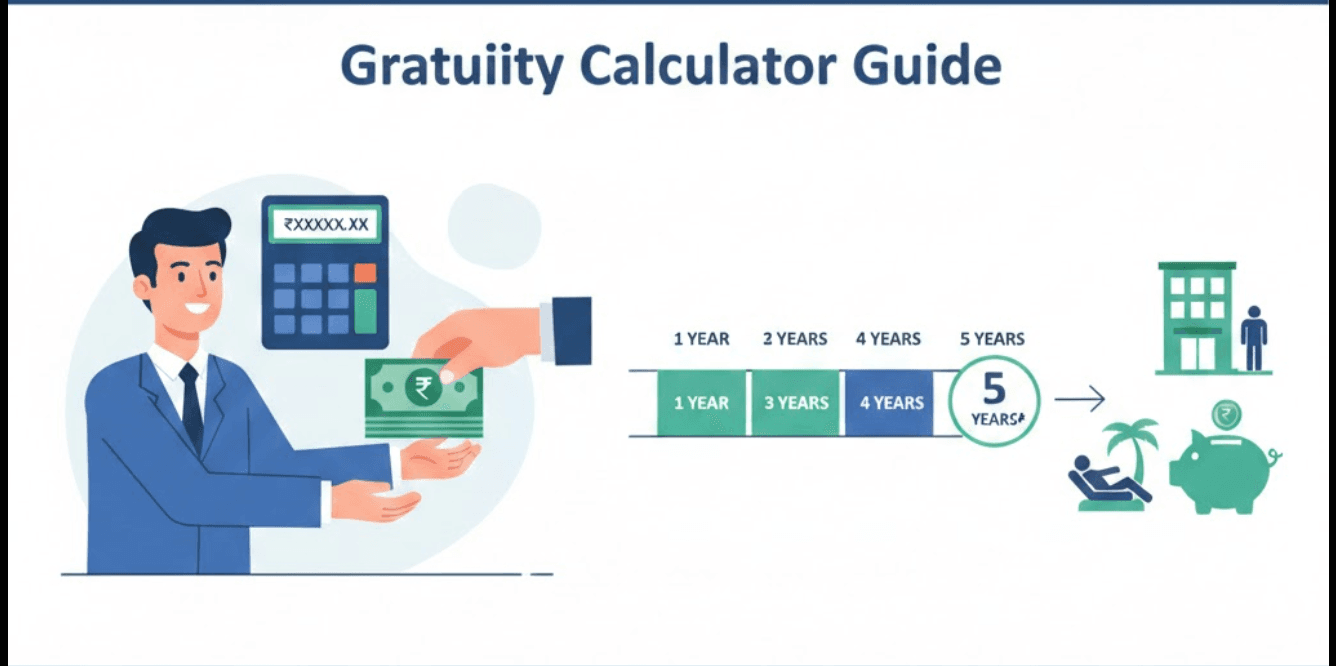
Gratuity is one of the few employment benefits that employees often see only at the time of exit, which is exactly why so much confusion surrounds it.
People mix up the gratuity line shown in CTC, the legal payout under the Act, the tax exemption, and the minimum-service rule. They are related, but not identical.
What Gratuity Is
Gratuity is a lump-sum payment made by an employer in recognition of service, subject to the applicable legal framework and employment conditions.
For many employees, the most practical questions are:
- •Am I eligible?
- •What salary figure is used?
- •How do completed years get counted?
- •How much is tax-free?
The Core Eligibility Rule
Under the commonly used framework for employees covered by the Payment of Gratuity Act, 1972, gratuity is generally associated with:
- •superannuation or retirement,
- •resignation after the minimum qualifying service,
- •death, and
- •disablement.
For many employees, the practical rule people remember is 5 years of continuous service, although death and disablement are treated differently. In real disputes, details such as service records and the applicable legal interpretation matter, so edge cases should not be handled casually.
The Formula Most Employees Need
For many Act-covered cases, the working formula is:
Gratuity = (15 x last drawn salary x completed years of service) / 26
Where:
- •last drawn salary usually means basic salary + dearness allowance,
- •15 represents 15 days' wages,
- •26 is used as the working-day denominator.
The biggest mistake employees make is using gross salary or CTC instead of the correct salary base.
Worked Example 1
Assume:
- •Basic salary: ₹40,000
- •Dearness allowance: ₹10,000
- •Completed service: 12 years
Gratuity = (15 x 50,000 x 12) / 26
         = ₹3,46,154 approximately
Worked Example 2
Assume:
- •Basic salary + DA: ₹90,000
- •Completed service: 18 years
Gratuity = (15 x 90,000 x 18) / 26
         = ₹9,34,615 approximately
This shows why salary structure matters. A higher basic-plus-DA base has a direct effect on the gratuity amount.
How Completed Years Are Usually Read
Employees often get confused on whether part-years count. Under the Act-based framework commonly discussed in payroll practice, service beyond a certain threshold within the year may be counted as a completed year for calculation purposes.
That is why "4 years and many months" disputes appear so often in gratuity discussions. But this is exactly the kind of edge case where you should rely on the employer's calculation sheet, service record, and where necessary, professional advice or the controlling authority, not social-media shortcuts.
Tax Treatment In Practice
Government employees
Gratuity is generally discussed as fully exempt for eligible government employees.
Private-sector employees
For many private-sector employees, the exempt amount is commonly understood as the least of:
- •actual gratuity received,
- •the applicable exemption ceiling, often discussed as ₹20 lakh, and
- •the eligible amount under the formula/rule that applies.
Simple example
Assume an employee receives ₹25 lakh as gratuity, but the eligible formula amount works out to ₹18 lakh.
- •Actual received: ₹25 lakh
- •Ceiling considered: ₹20 lakh
- •Formula amount: ₹18 lakh
The exempt amount is ₹18 lakh, because it is the lowest of the three. The balance is taxable.
Common Mistakes
Using gross salary instead of basic plus DA
This is the most common calculator error.
Assuming the gratuity shown in CTC is the same as final payout
Many employers include a gratuity component in CTC planning, but the actual payout at exit depends on legal eligibility, salary base, and completed service.
Treating every online "4 years 240 days" claim as universal
This topic has nuance. Do not resign purely based on an internet summary without checking your actual service record and legal position.
Ignoring tax at the time of exit
A large payout does not automatically mean the entire amount is tax-free.
What To Check Before You Leave A Job
- •Confirm your exact date of joining and last working date.
- •Confirm the salary base being used: basic plus DA.
- •Ask HR for the gratuity calculation sheet.
- •Check whether any part of the payout may be taxable.
- •Keep payslips, appointment letters, and exit records safely.
Claim And Payment Discipline
At exit, do not treat gratuity as an informal favour from the employer. It is a statutory matter where applicable. Ask for the computation, timeline, and any required forms in writing. If there is a dispute or unexplained delay, document everything.
Bottom Line
Gratuity is not complicated once you separate the moving parts.
Use the right salary base, count service carefully, and understand that the tax exemption is not simply "whatever amount the company pays". If you do those three things, most gratuity confusion disappears.
Frequently Asked Questions
Is gratuity part of CTC?+
Do I get gratuity if I change jobs early?+
Is gratuity fully tax-free?+
Sources & References
- [1] Payment of Gratuity Act 1972ReferenceVerified: 4 Jun 2026
- [2] Ministry of LabourReferenceVerified: 4 Jun 2026
Disclosure & Update History
This content is for educational purposes only and is not personalized financial, tax, or legal advice.
Update history
- Originally published on 5 December 2025.
- Latest editorial review completed on 4 June 2026.
- Sources cited on this page are reviewed during each editorial refresh.
Tags
Written by Amodh Shetty
Amodh is a personal finance educator and the founder of KnowYourFinance. He focuses on Indian taxation, investing, insurance, and household decision-making frameworks.
Editorial disclosure: The author holds investments in broad-market index funds and SGBs. This article is strictly for educational purposes and does not constitute professional investment advice.
Need Calculators Alongside the Guide?
The article stands on its own. If you want an iPhone companion for running scenarios, saving inputs, and using India-focused calculators, you can use the KnowYourFinance app.
Explore the iPhone App