The "Easy Money" Mirage
Open Instagram/YouTube. You see a 22-year-old in a rented Mercedes showing a screenshot: "Profit: ₹5 Lakhs in 1 Day!" He sells a course: "Master BankNifty Options in 2 Hours."
This is the modern-day Gold Rush. And like every gold rush, the only people getting rich are the ones selling shovels (Brokers & Course Sellers).
The Securities and Exchange Board of India (SEBI) released a bombshell report in 2025. It didn't just say traders lose money. It proved that Trading is a mathematical suicide mission for retail investors.
Let's decode the First Principles of why you will almost certainly lose.
Part 1: The SEBI Data (The Funeral of Capital)
The numbers are not "estimates". They are factual data from millions of demat accounts.
- •Loss Probability: 91% of individual traders lost money in F&O (FY25).
- •Average Loss: The average loser wiped out ₹1.1 Lakhs of their hard-earned capital.
- •The "Profitable" 9%: Even among the 9% who made a profit, the majority made less than a Fixed Deposit return after adjusting for stress and time.
- •The Top 1%: Only ~1% of active traders made more than a standard salary. Are you really in the top 1% of the country's smartest mathematical minds?
The Trap: You enter thinking you are the "Wolf of Dalal Street". The data says you are the sheep.
Part 2: The "House Edge" (Transaction Costs)
In a Casino, the "House Edge" (Roulette Zero slot) ensures the casino wins over time (approx 5%). In F&O, the "House Edge" is Brokerage + Taxes.
Let's look at the math of a "Breakeven" trader. Assume you buy a Nifty Call Option at ₹100 and sell at ₹100. Profit = ₹0? WRONG.
The Cost of "Doing Nothing":
- •Brokerage: ₹20 Buy + ₹20 Sell = ₹40.
- •STT (Securities Transaction Tax): 0.1% on Turnover (Huge impact).
- •Exchange Charges: NSE/BSE fees.
- •GST: 18% on Brokerage.
- •Stamp Duty: State taxes.
Result: To just break even, your trade needs to move 0.5% in your favor. If the market stays flat, you lose. If the market moves slightly against you, you lose big. If the market moves slightly in your favor, you break even. You only win if the market moves MASSIVELY in your favor.
You are running a race with a 10kg sandbag tied to your leg.
Part 3: The Opponent (Algos vs You)
Who is on the other side of your trade?
- •Is it another guy named Rahul from Mumbai? No.
- •It is a High-Frequency Trading (HFT) Algorithm from Goldman Sachs or Tower Research.
The Mismatch:
- •YOU: Look at a chart, feel "market looks bullish", click Buy. (Lag: 2 seconds).
- •ALGO: Processes 10,000 data points (Global cues, Currency, Bond yields, Order flow), executes trade. (Lag: 2 microseconds).
The Algo sees your order coming before you even finish clicking. It buys ahead of you and sells to you at a higher price. You are playing Chess against Stockfish 16. You might win a pawn once by luck. You will lose the game every single time.
Part 4: The Psychology Trap (Dopamine)
Why do you keep trading despite losing? Because F&O is designed like gambling.
- •Variable Reward: Sometimes you win ₹5000 in 2 minutes.
- •Dopamine Hit: That "win" releases dopamine in your brain.
- •The Loss: When you lose ₹10,000, your brain says "Just one more trade to recover."
Revenge Trading: You try to "recover losses". You take bigger risks. You lose more. It is an addiction spiral, exactly like a slot machine. We have seen people wipe out their Parents' Pension and Home Loan Downpayments chasing this dopamine.
Part 5: The Verdict (The Only Way to Win)
How do you win at F&O? By not playing.
The Wealth Formula:
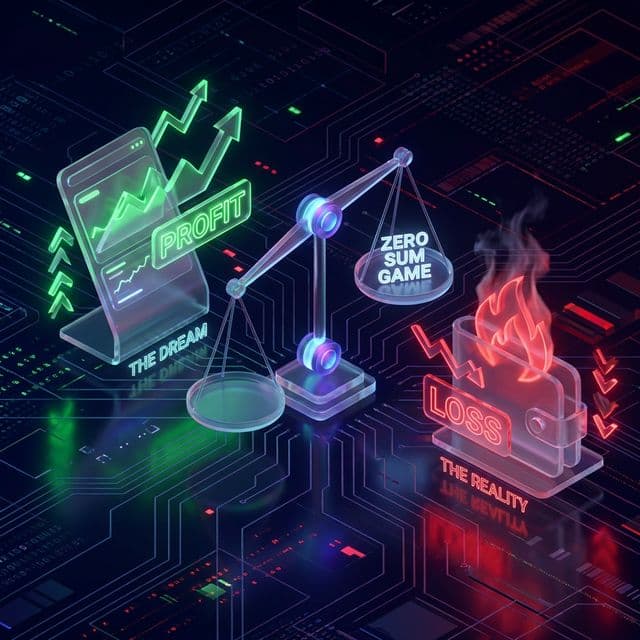
- •Trading: Zero Sum Game (Your gain is someone else's loss).
- •Investing: Positive Sum Game (Companies create value, everyone wins).
Action Plan:
- •Stop Trading: Delete the F&O segment from your broker app.
- •SIP It: Take that ₹10,000 you were going to burn in Options. Put it in a Nifty 50 Index Fund.
- •Wait: In 10 years, the Trader will have ₹0. The Investor will have ₹25 Lakhs.
The Final Word: F&O is for Hedging (Insurance for big portfolios). Retailers use it for Speculation (Gambling). Don't be the liquidity for the big banks. Be the owner of the big banks (Buy their stock).
Frequently Asked Questions
Why do many F&O traders lose money?+
Is F&O investing?+
Can risk management guarantee profit?+
Sources & References
- [1] SEBI Study on Intraday TradingRegulatorVerified: 15 Feb 2026
- [2] NSE Market DataExchangeVerified: 15 Feb 2026
Disclosure & Update History
This content is for educational purposes only and is not personalized financial, tax, or legal advice.
Update history
- Originally published on 15 February 2026.
- Latest editorial review completed on 15 February 2026.
- Sources cited on this page are reviewed during each editorial refresh.
Tags
Written by Amodh Shetty
Amodh is a personal finance educator and the founder of KnowYourFinance. He focuses on Indian taxation, investing, insurance, and household decision-making frameworks.
Editorial disclosure: The author holds investments in broad-market index funds and SGBs. This article is strictly for educational purposes and does not constitute professional investment advice.
Need Calculators Alongside the Guide?
The article stands on its own. If you want an iPhone companion for running scenarios, saving inputs, and using India-focused calculators, you can use the KnowYourFinance app.
Explore the iPhone App