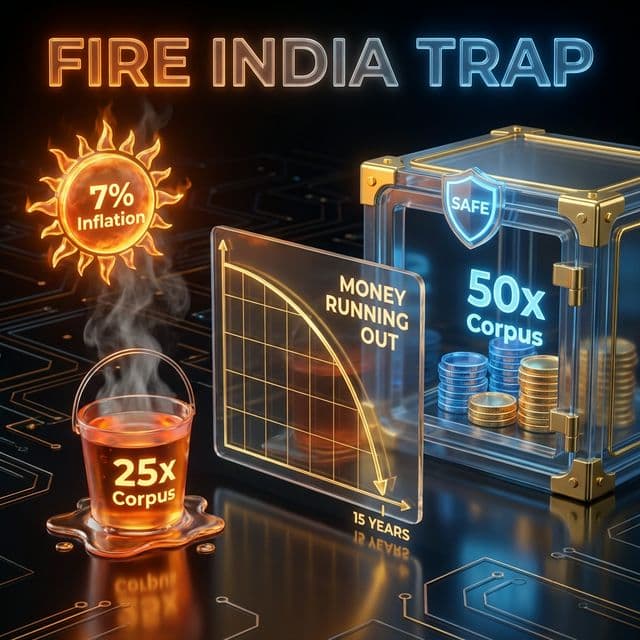
The 25x rule is one of the most useful shortcuts in personal finance and one of the most misused.
It is useful because it gives people a quick mental model for financial independence.
It is misused because many people turn that shortcut into a guarantee.
That is where the real problem begins.
What the 25x rule is trying to say
If your annual spending is ₹12 lakh, then 25x says you need roughly ₹3 crore.
The intuition is tied to a roughly 4% initial withdrawal rate:
- •annual spending = ₹12 lakh
- •corpus = ₹3 crore
- •first-year withdrawal = 4%
This is not absurd math. It is just incomplete math.
Why one number is not enough for an Indian FIRE plan
Your actual result depends on:
- •inflation,
- •taxes,
- •sequence of returns in the first few retirement years,
- •how long retirement lasts,
- •and whether your spending is truly flat or full of future shocks.
That last point matters a lot. Many FIRE calculators act as if retirement spending is one neat annual number. Real life includes parents, repairs, health events, weddings, travel, and uneven market years.
A simple stress test
Assume:
- •corpus: ₹3 crore
- •first-year spending: ₹12 lakh
- •spending rises with inflation each year
Now look at what happens under a few simplified return-and-inflation combinations.
| Scenario | Assumed return | Assumed inflation | Simplified result |
|---|---|---|---|
| Case A | 10% | 6% | corpus still survives after 60 years in this deterministic example |
| Case B | 10% | 7% | corpus runs out in about 42 years |
| Case C | 9% | 6% | corpus runs out in about 42 years |
| Case D | 9% | 7% | corpus runs out in about 34 years |
These are not forecasts. They are illustrations. The lesson is that a one-percentage-point change in return or inflation can completely change the sustainability story.
That is why both of these statements can be wrong:
- •"25x always works."
- •"You always need 50x."
What Indian households often underestimate
Taxes
Your spendable return is not the same as your pre-tax portfolio return.
Uneven inflation
Headline CPI is useful, but your personal inflation basket may be very different if healthcare, school fees, rent, or domestic help dominate your spending.
Long retirement horizon
Retiring at 40 is not the same planning problem as retiring at 58. The number of years you need the portfolio to support is central to the calculation.
Sequence risk
Bad market returns in the first few years of retirement can do more damage than weak returns later.
A better way to think about FIRE in India
Instead of asking only, "What is my number?", ask:
- •What are my essential annual expenses?
- •What are my discretionary expenses?
- •Which future costs are lumpy and should not be hidden inside my monthly spending estimate?
- •What assumptions am I making about inflation, taxes, and future returns?
That leads to a healthier design.
Bucket 1: Core living expenses
These are the expenses your household cannot avoid.
Bucket 2: Discretionary lifestyle
Travel, upgrades, and nice-to-have spending should not be treated with the same rigidity as food, utilities, and basic housing.
Bucket 3: Non-portfolio shocks
Emergency cash, health cover, and major one-off goals should not all be expected to come from one neat annual withdrawal line.
So what multiple should you use?
There is no honest single answer for everyone.
But there is a better process:
- •treat 25x as an early screening heuristic,
- •run your plan at lower withdrawal assumptions such as 3% to 3.5%,
- •and test harsher inflation and lower-return scenarios before making a career decision.
For many households, the real requirement may end up looking like:
- •30x to 40x for core living costs,
- •plus separate buffers for health, parents, housing repairs, and children's goals.
If you also expect some part-time income, consulting, rent, or flexible spending cuts in bad years, the plan becomes safer. If you expect your corpus alone to carry everything with no adaptability, the margin needs to be larger.
Common FIRE planning mistakes
Using pre-tax returns in a post-retirement plan
That overstates sustainability.
Ignoring health insurance and later-life healthcare
The FIRE corpus should not be your only defence against health shocks.
Counting future inheritance or property sale as if it is guaranteed
That is not a margin of safety. That is wishful planning.
Treating 25x as permission instead of a starting estimate
This is the most common mistake of all.
The practical takeaway
The 25x rule is not useless. It is just too thin to carry a full Indian retirement plan on its own.
Use it as a starting point, then stress-test the plan hard enough that a bad decade does not automatically ruin the next thirty years.
Frequently Asked Questions
Is 25x enough for India FIRE?+
What buffer should FIRE planning include?+
Can part-time income improve FIRE safety?+
Sources & References
- [1] RBI publication on India's inflation targeting frameworkRegulatorVerified: 4 Jun 2026
- [2] RBI Monetary Policy Committee publicationRegulatorVerified: 4 Jun 2026
- [3] MOSPI CPI releasesReferenceVerified: 4 Jun 2026
Disclosure & Update History
This content is for educational purposes only and is not personalized financial, tax, or legal advice.
Update history
- Originally published on 19 February 2026.
- Latest editorial review completed on 4 June 2026.
- Sources cited on this page are reviewed during each editorial refresh.
Tags
Written by Amodh Shetty
Amodh is a personal finance educator and the founder of KnowYourFinance. He focuses on Indian taxation, investing, insurance, and household decision-making frameworks.
Editorial disclosure: The author holds investments in broad-market index funds and SGBs. This article is strictly for educational purposes and does not constitute professional investment advice.
Need Calculators Alongside the Guide?
The article stands on its own. If you want an iPhone companion for running scenarios, saving inputs, and using India-focused calculators, you can use the KnowYourFinance app.
Explore the iPhone App