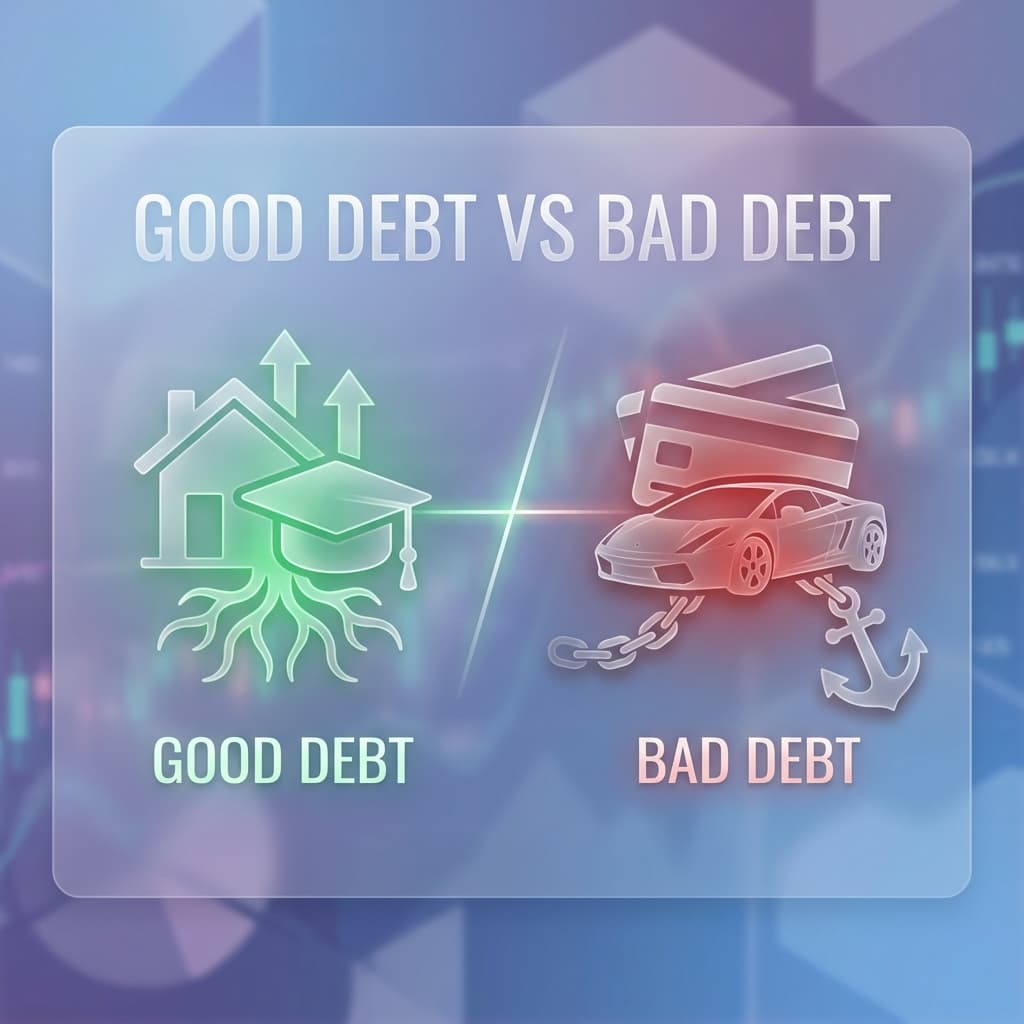
The phrase "good debt" is useful only if you use it carefully. Otherwise it becomes an excuse for borrowing too much.
Debt is not productive just because it has a respectable label. A home loan, an education loan, or a business loan can all go wrong if the cash flow is weak, the assumptions are unrealistic, or the borrower has no margin for error.
The First Test: What Does The Debt Buy?
Borrowing is usually easier to defend when it helps create one of these:
- •future earning power,
- •a productive business asset,
- •or a long-lived asset you can responsibly afford.
Borrowing is usually harder to defend when it finances:
- •lifestyle inflation,
- •fast-depreciating purchases,
- •or spending you could not afford in cash.
A Better Rule Than "ROI > Interest"
The common shortcut is:
If return on investment is greater than interest cost, the debt is good.
That is directionally useful, but incomplete. You also need to ask:
- •Is the expected return realistic?
- •Is the cash flow stable enough to service the loan?
- •What happens if things go wrong for 12 months?
Debt is only truly manageable when both the economics and the household resilience make sense.
Example 1: Education Loan
Education borrowing can be productive if it leads to a meaningful improvement in earnings.
Suppose a professional spends ₹8 lakh on a degree and finances part of it through an education loan. If the post-course salary rises from ₹4 lakh a year to ₹9 lakh a year, the borrowing may be justified because the income base itself changes.
But the label "education" does not make every loan good. If the course is overpriced or has weak placement outcomes, the debt can become a burden rather than an investment.
Example 2: Business Borrowing
Assume a small business can borrow at 12% and deploy capital at a genuine 20% return on capital employed.
That is productive leverage in principle.
But if the owner borrows for inventory with poor turnover, weak margins, and no emergency buffer, the same 12% loan becomes dangerous very quickly. Productive debt still requires disciplined execution.
Example 3: Home Loan
A home loan sits in the middle. It is not always "good debt" and not always "bad debt".
If the house is self-use, part of the return is lifestyle value and housing stability, not just pure investment return. That means you should be careful about calling it a wealth-building loan automatically.
If the EMI is manageable, the emergency fund exists, and the home purchase fits the family plan, it can be a reasonable liability. If the EMI consumes most of your breathing room, the same loan can make the household fragile.
Example 4: Credit-Card Rollover
This is the cleanest example of destructive debt.
If you revolve a card balance at very high annualised cost to finance discretionary spending, there is usually no productive asset and no earnings benefit being created. You are simply moving present consumption into a much more expensive future.
A Simple Borrowing Ladder
Usually strongest candidates for productive debt
- •education loans with credible return on skill,
- •business borrowing with proven cash generation,
- •modest home loans within a stable budget.
Usually weak or dangerous
- •long-tenure car debt on stretched budgets,
- •personal loans for discretionary spending,
- •credit-card rollover,
- •consumer EMI for gadgets you could not otherwise afford.
The Cash-Flow Test Matters More Than Theory
A family with take-home pay of ₹1 lakh and fixed EMIs of ₹55,000 may look fine on paper if the loan is for an "asset". In practice, one job shock can turn that into crisis.
That is why debt should always be tested against:
- •emergency fund strength,
- •monthly free cash flow,
- •job stability,
- •and other existing liabilities.
Common Mistakes
Calling every house loan "good debt"
If the EMI is choking your savings rate and your emergency fund is weak, the label does not help.
Using future salary assumptions too casually
Many borrowers justify loans with income growth that has not happened yet.
Ignoring total debt load
A reasonable home loan plus reckless card use can still become a bad overall debt profile.
Treating leverage as sophistication
Borrowing is not advanced wealth building by itself. Good leverage is boring, measured, and cash-flow-aware.
A Practical Decision Framework
Before taking any loan, ask:
- •What exactly am I buying?
- •Does it improve earning power, business cash flow, or long-term stability?
- •Can I handle the EMI if income falls temporarily?
- •Do I still have an emergency fund after taking the loan?
If you cannot answer those cleanly, the debt is probably not as good as it sounds.
Bottom Line
Good debt is not about status. It is about productive use, realistic return, and resilient repayment capacity.
Bad debt is not just expensive debt. It is debt that finances weak decisions and leaves you with little room to recover when life goes off-script.
Frequently Asked Questions
Is all debt bad?+
What is the biggest debt warning sign?+
Should I invest while having debt?+
Sources & References
- [1] RBI Financial Stability ReportRegulatorVerified: 4 Jun 2026
- [2] CIBIL Consumer InsightsReferenceVerified: 4 Jun 2026
Disclosure & Update History
This content is for educational purposes only and is not personalized financial, tax, or legal advice.
Update history
- Originally published on 2 February 2026.
- Latest editorial review completed on 4 June 2026.
- Sources cited on this page are reviewed during each editorial refresh.
Tags
Written by Amodh Shetty
Amodh is a personal finance educator and the founder of KnowYourFinance. He focuses on Indian taxation, investing, insurance, and household decision-making frameworks.
Editorial disclosure: The author holds investments in broad-market index funds and SGBs. This article is strictly for educational purposes and does not constitute professional investment advice.
Need Calculators Alongside the Guide?
The article stands on its own. If you want an iPhone companion for running scenarios, saving inputs, and using India-focused calculators, you can use the KnowYourFinance app.
Explore the iPhone App