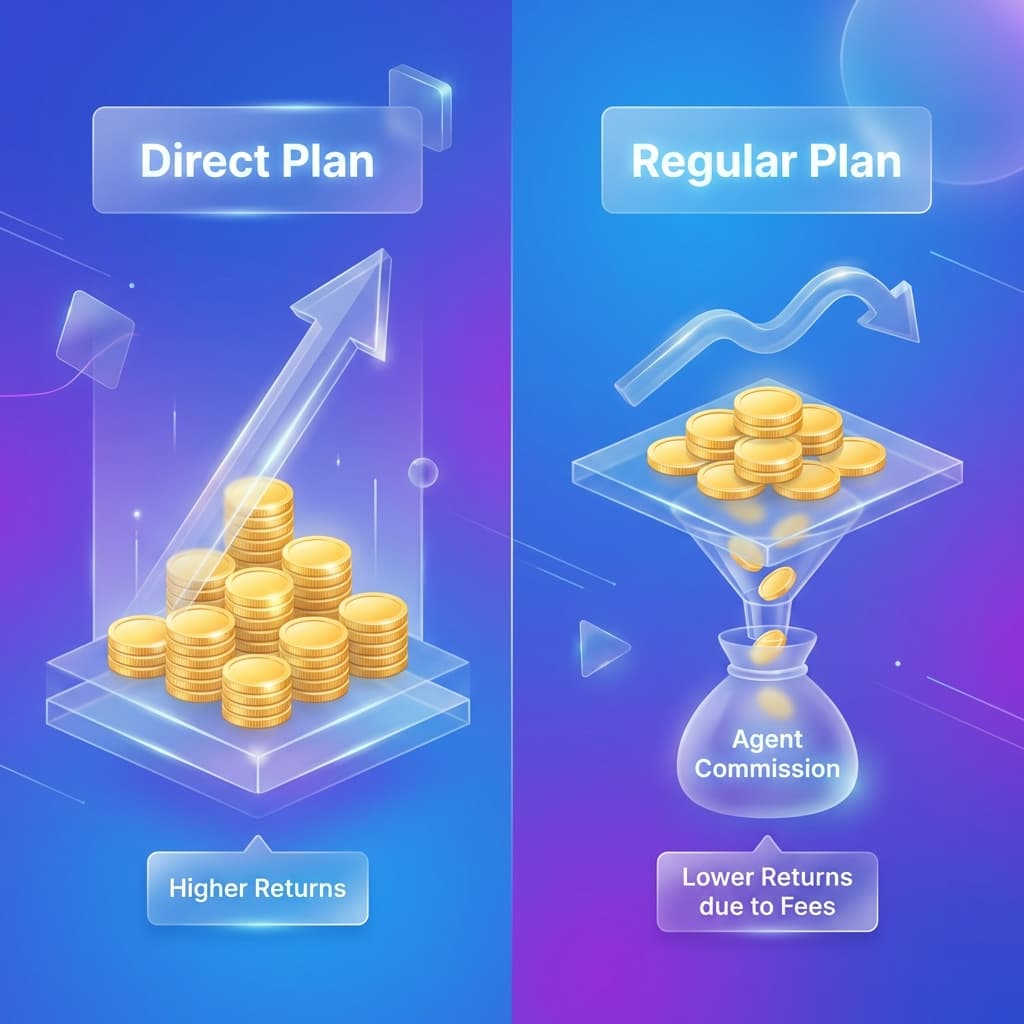
The direct-vs-regular debate looks small on day one and huge after 15 to 20 years. That is because the underlying investment is often the same; the long-term difference comes from cost.
What Actually Changes Between Direct And Regular
For the same mutual fund scheme:
- •the fund manager is usually the same,
- •the portfolio is the same,
- •the mandate is the same.
The main difference is distribution cost.
In a regular plan, the expense ratio includes distributor or intermediary compensation.
In a direct plan, that layer is absent, so the cost is lower and the NAV compounds slightly faster over time.
Why Small Cost Differences Become Big
Suppose you invest ₹50,000 a month for 20 years.
| Scenario | Assumed annual return | Approx corpus after 20 years |
|---|---|---|
| Direct plan | 12% | about ₹5.00 crore |
| Regular plan | 11% | about ₹4.37 crore |
The difference is roughly ₹62.8 lakh.
That is the key lesson. The gap does not come from one bad year. It comes from paying an extra layer of cost every year on a growing pool of money.
Why Many Investors Still End Up In Regular Plans
Regular plans often enter the portfolio through:
- •bank relationship managers,
- •insurance-oriented distributors,
- •offline advisers who are compensated through trail commissions,
- •or investors who simply never noticed the difference at onboarding.
None of this means the investor made a foolish choice. It often just means the cost structure was not explained clearly enough.
How To Check What You Own
Open your statement, CAS, AMC portal, or broker dashboard and look at the scheme name carefully.
You want to know whether it explicitly says Direct or Regular. If it is regular, the long-term cost drag is real even if the portfolio has performed well.
When Direct Plans Usually Make Sense
Direct plans are the natural default when:
- •you can choose and monitor your own funds,
- •you are comfortable using an AMC portal or direct platform,
- •or you already know that you want a simple long-term SIP setup.
When Paying For Advice Can Still Be Reasonable
This does not mean investors should never pay for help.
There is a legitimate difference between:
- •paying hidden ongoing commission inside a regular plan, and
- •paying a transparent adviser fee for actual planning work.
If an adviser genuinely helps with asset allocation, behaviour, tax planning, and portfolio discipline, paying a clear fee can be sensible. The issue is not paying for advice. The issue is paying for distribution without understanding the cost.
How To Switch Carefully
For future SIPs
The cleanest first step is often:
- •stop new SIPs into the regular plan,
- •start fresh SIPs in the direct version of the same fund or an alternative you have chosen deliberately.
For existing units
Do not shift blindly.
Check:
- •exit load,
- •capital gains tax,
- •and whether the fund still deserves a place in your portfolio at all.
If the fund itself is weak, the answer may not be "same fund, direct plan". It may be "better fund structure altogether".
Common Mistakes
Looking only at one year of difference
The real gap emerges over long horizons.
Switching without checking tax or exit load
A rushed move can create avoidable friction.
Staying in a bad fund just because it has a direct option
Direct is cheaper than regular, but cheap is not the same as appropriate.
Bottom Line
Direct plans usually win the long-term math because they remove one ongoing layer of cost.
If you are already comfortable choosing funds, they are usually the cleaner default. If you need advice, pay transparently for advice rather than unconsciously paying for distribution forever.
Frequently Asked Questions
Why do direct plans usually show higher returns?+
Are regular plans always wrong?+
Can I switch from regular to direct?+
Sources & References
- [1] SEBI Mutual Fund RegulationsRegulatorVerified: 4 Jun 2026
- [2] AMFI Commission DisclosureOfficialVerified: 4 Jun 2026
Disclosure & Update History
This content is for educational purposes only and is not personalized financial, tax, or legal advice.
Update history
- Originally published on 1 February 2026.
- Latest editorial review completed on 4 June 2026.
- Sources cited on this page are reviewed during each editorial refresh.
Tags
Written by Amodh Shetty
Amodh is a personal finance educator and the founder of KnowYourFinance. He focuses on Indian taxation, investing, insurance, and household decision-making frameworks.
Editorial disclosure: The author holds investments in broad-market index funds and SGBs. This article is strictly for educational purposes and does not constitute professional investment advice.
Need Calculators Alongside the Guide?
The article stands on its own. If you want an iPhone companion for running scenarios, saving inputs, and using India-focused calculators, you can use the KnowYourFinance app.
Explore the iPhone App